
Essays
I Would Like to Buy $3 Worth of God, Please (vol. 2)
This is the second in a three-part series of posts based on the following quote:
I would like to buy $3.00 worth of God, please. Not enough to explode my soul or disturb my sleep, but just enough to equal a cup of warm milk or a snooze in the sunshine. I don’t want enough of Him to make me love a black man or pick beets with a migrant. I want ecstasy, not transformation; I want the warmth of the womb, not a new birth. I want a pound of the Eternal in a paper sack. I would like to buy $3.00 worth of God, please. – Tim Hansel on most Christians’ priorities.
This second post was written by my friend, Tom Kaden. Tom came on staff at Engage Community Church when I was associate pastor and filled in for me when I took leave to have the twins. About six months later Tom and his wife Sarah found out they too were having twins, so our families now mirror each other, since they also already had two older children. They welcomed two beautiful baby girls into the world about six weeks ago. Tom continues to lead at Engage and has also started a non-profit counseling ministry called Someon To Tell It To. Tom and his business partner Michael blog at Someone to Tell it To.
* * * * *
There is a three letter
word that maneuvers its way into our vocabulary and it is quite possibly more
damaging and destructive to our well-being and the well-being of those around
us than most of the four letter words our society deems as immoral. This three letter word rears its ugly head
nearly every time we ask our children to clean their play rooms; it rears its
ugly head nearly every time we are asked to do something uncomfortable or
painful by our boss or co-worker (even if it isn’t voiced out loud); it even
rears its ugly head in the lives of those of us who call ourselves faithful
followers of our “Lord” Jesus Christ when we read passages in the Bible which
make hairs stand up on the backs of our neck.
If you haven’t guessed it just yet, then you just lost at our game of
hangman.
The three letter word I am thinking of is the word: BUT…!!!
Maybe you are
sitting at your job and a co-worker just asked you if you could help him with a
minor issue he is faced with on his computer.
You are in the middle of an important project and you have a looming
deadline hanging over your head. Guess
what word just popped into your head? It’s
that destructive word: BUT…!!! “I’ll
help you BUT…I really need to get this project done first. Or, maybe your spouse asked you to help
change a diaper (or two), but your favorite team or show is on television and
you don’t want to miss a minute of it.
There it is again, that damaging word: BUT…!!! “I’ll help you, BUT…can it wait until the
next commercial?”
Do you resonate with
those examples? If not, how about this
one? This morning before you started
your quiet time of meditation on the Gospel of Mark, you prayed out loud,
“Lord, today I recommit myself as your disciple. You are the Lord of my life. Direct my path today.” After you are finished, you pick up your
Bible and continue your study on the Gospel of Mark. Today’s passage is the story of the Rich
Young Ruler. You read the story and
your eyes read verse 21 as quickly as possible where Jesus says: 21″You
lack one thing; go, sell what you have, and give to the poor, and you will have
treasure in heaven; and come, follow me.”
“BUT,” you think, “…surely, not I Lord.Surely that passage isn’t meant for me.I’m barely making enough money to support our family of five.I know this passage reads, sell everything you own and give to the poor, BUT…I have a family to feed.I can’t give out of nothing!” There it is again, that three letter word
which has so much become part of your vocabulary that it leaves you further and
further from experiencing the truth of the Gospel in your own life.
The truth is the three-letter word BUT could be used for good in our lives. It doesn’t always carry with it such negative connotations if used as another reminder of how the Gospel has changed us and the model that has been laid before us. For example, in Philippians chapter 2, Paul says (of Christ):
6 Who,
being in very nature God,
did
not consider equality with God something to be used to his own advantage;
7 BUT,
he made himself nothing
by
taking the very nature of a servant,
being
made in human likeness.
8 And being found in appearance as a man,
he
humbled himself
by
becoming obedient to death—
even death on a cross!
Notice
in this passage how Paul uses the three letter word “BUT”, yet he puts a much
more positive twist on it. He reminds
us, as he was reminding the church hundreds of years ago, that Christ Jesus,
even though He was equal with God, set aside His rights–to serve us. He willingly chose to not use that fateful
word as a roadblock to loving others, but instead as the foundation for His
goodness, grace, and compassion.
So
maybe for us the takeaway is this: Yes, you have a family of five to feed on
very little income, BUT…God has given you something or some way to love, bless,
and serve His kingdom. Yes, your spouse
just asked you for a second time to change your daughter(s) diapers, BUT…this
time in your daughter(s) lives is fleeting and these moments will end soon and
there will always be another game or another show to watch. Yes, your co-worker just asked you to help
him with his computer glitch for the third time today, BUT…God has given you an
amazing opportunity to use your gifts to be a blessing to your co-worker in a
way that maybe no one else in the office can.
Today I am reminded of Christ’s example of
humility and grace and openness to God’s transformative power. I am reminded of the great length He has gone
and continues to go to extend His unconditional love and mercy to us. This changes everything because our
motivation isn’t a means of trying to earn God’s love and approval and it’s
also not just about us as individuals which the negative use of the word BUT
often implies. Christ used the word BUT
not as a way to close doors or miss opportunities to extend love, compassion,
and grace; instead, used the word as a means of opening His very life and ours
to the amazing grace, abundant compassion, and absolute love.
[Stay tuned for my take on this quote and, as always, I’d love to hear your thoughts too. I’m sure Tom would enjoy hearing your comments. If you like this piece, take a few minutes to explore the blog posts on his website – you won’t be disappointed.]
I’d Like to Buy $3 Worth of God, Please (vol. 1)
Over the next several days I’m hosting a series of three posts on the following quote:
I would like to buy $3.00 worth of God, please. Not enough to explode my soul or
disturb my sleep, but just enough to equal a cup of warm milk or a snooze in the
sunshine. I don’t want enough of Him to make me love a black man or pick beets
with a migrant. I want ecstasy, not transformation; I want the warmth of the
womb, not a new birth. I want a pound of the Eternal in a paper sack. I would like to buy $3.00 worth of God, please. – Tim Hansel on most Christians’ priorities.
This first post was written by my friend, Matt Tuckey. I got to know Matt through shared time on our church’s board. I always appreciate the depth of thought and feeling he brings to everything he does. Matt is the Associate Executive Director of our local YMCA and blogs at Living Openhanded and Y Thoughts. He has two boys, ages fiveand seven, and a wonderfully talented wife. My own faith journey has been made easier and less lonely by the presence of Matt and his wife.
* * * * *
Some contend that a crusade is in effect on the Christian faith or, at least, on the
morals and values our society. Perhaps, but more so I see a culture that is very amiable to
religion given that it’s practiced within the parameters currently deemed
appropriate. I work in the health and wellness industry and I consistently see
the inclusion of spirituality as a widely accepted key ingredient to holistic
wellness. Certainly what’s generally accepted by society is spirituality in
it’s most general sense. Whatever one sees as truth is ok, as long as you’re
connecting to something beyond yourself.
Current best practice
says that our lives should reflect the makeup of a salad with a healthy mix of
nutrient rich greens, diverse fruits, low-fat protein, and a few sunflower seeds
sprinkled atop. In the same way, it’s projected that our lives should include a
desirable dose of emotionally rich experiences, diverse community for social
health, physical exercise, and some type of spirituality sprinkled atop.
Perhaps, but this isn’t the makeup of life that truly redeems, restores, and
recreates us. Instead, it’s fast food life that tastes good and fills us, but
doesn’t sustain us. It’s $3.00 of God.
In many ways my life
has been built around the constructs of control. I’ve navigated my ship and
crafted my destiny. Or so I thought. This illusion of control was rooted in a
lie that I told myself long ago. “Don’t let yourself get attached to
anything you are not willing to walk out on in 30 seconds flat…” This line
was made famous in the 1995 film, Heat. The film followed a thief and the
detective that pursued him, both lonely broken men isolated by this mantra that
defined them. Unfortunately, this idea rooted itself into my magical world of
controlled environments, relationships, and situations. It was safe. I was
able to toss together my life with a mix of what I wanted on my terms, complete
with a bit of God sprinkled atop. My $10 life included an evenly proportioned
$3.00 of God. The destiny I pursued was ecstasy, not transformation.
God isn’t positioned
to be consumed in a drive thru. God isn’t a value meal to be efficiently
devoured on the way to the next appointment. God isn’t an evenly proportioned
part of our holistic wellness. And, God isn’t a healthy topping sprinkled upon
our lives. God wants to be the dressing. God wants to saturate all that’s in
our lives. God doesn’t want to be an ingredient, but rather the taste that
defines every other part of our lives. God wants to explode our souls,
transform our hearts, and to completely make us new.
It’s in our faith that
we find wellness. As Matthew recounts the story of Jesus’ life, he tells
of three occasions where faith is the verge of the miraculous. (See Matthew
8:10, 9:21, 9:29). In each account, an individual comes before Jesus dragging
with them a faith-saturated life that’s a broken remnant of what they’d dreamt.
And in each story, Jesus changes their reality on the spot. This transformation
happens not because they’ve strategically positioned themselves to appropriately
request favor or because they’ve created a life that has an open slice for Jesus
to enter in, but only because they’re dripping with faith.
I’ve learned that my
illusory world of control wasn’t sustainable. I’m learning that God desires
mercy not sacrifice. I’m learning that God wants my trust and faith so that I
might find rest. I’m learning that, as Tim Keller says, Jesus isn’t at the top
of the stairs staring down to me directing me to ascend to Him, but instead Jesus is the stairs.
It’s safe, culturally
acceptable, and comfortable to purchase $3.00 of Jesus. Countless people do it
every Sunday. I’ve done it for too long. For a control freak like myself, it’s
scary to pray for a life saturated by God. This means change. It means
surrender. It’s daunting to imagine a life rooted in trust and faith without my
vain attempts at control. It’s easy to dismiss this type of life for those who
can’t handle their own. Yet, it’s what God dreams for us, his children. A life
reliant on Him is one He knows brings us to our fullest sense of who we were
created to be – magnificent beings that shine like stars in the universe,
all-stars of the highest order.
I am thankful that God
hasn’t granted me my subtle desire to have a life void of relationships that I
could walk away from in 30 seconds flat. I don’t know why God’s tilled my heart
over the past few years to uproot the lies and replant seeds of purpose, sprouts
of faith. It hasn’t been easy. But, I believe that God’s up to bigger things.
I believe He’s using my humble story in some small way as he continually drafts
His story. I believe that He’s reorienting my life because I’m loved and
accepted and forgiven. I believe that God is saddened when I pursue only $3.00
of Him, a limited portion of all that’s good. And I believe that He reclines
and laughs heartily as I write this, because He’s brimming with excitement about
what He’s doing, about the stories He’s interweaving with redeeming grace. I
believe His smile is large as He looks upon us with anticipation, knowing what’s
to come before we do, understanding that when we’re immersed in Him,
we’re sinking wonderfully in grace.
God, may I never
undervalue you again. May I see all things through your eyes. May I pay full
attention to what you’re doing all around. May I never be comfortably
complacent, but always hopefully challenged. May I continue to stand arms
outstretched and openhanded in the showers of grace. Immerse us, saturate us,
and soak us in all that you’ve imagined for us. May we never settle for less
than You. May we always desire more of You.
[Stay tuned for two more takes on this quote to be posted over the next couple of days. I’d love to hear your take on it too . . . and I’m sure Matt would enjoy hearing your comments. If you like this piece, take a few minutes to explore his blog posts – you won’t be disappointed.]
I Don’t Want to Miss the Feast (Today @ Sheloves/Magazine)
I’m grateful to have a post published today over at SheLoves/Magazine. (For all of my male readers, don’t worry, only the first part is about breastfeeding!) I’d love to hear your comments either here or there and, as always, feel free to share.
* * * * *
I sat on the couch, a baby under each arm, and prepared to nurse my five-month-old twins. I steeled myself, braced against the pain–the feeling like shards of glass and fire shooting through my breasts – as their hungry little mouths latched on. The fierce latch I’d been so grateful for when they were newborns now filled me with anxious dread.
I’d nursed my older two without problems, but a few months in with the twins I began to experience intense pain. My skin was cracked and bleeding and each feeding was misery. I saw two different doctors and tried multiple prescriptions before finally learning I had an intraductal yeast infection. I spent months downing rounds of oral medications and applying lotions and creams. I searched the internet for solutions. I treated both babies with syringes of liquid medicine, at times giving eight doses a day between the two of them.
Click here to continue reading this story about sitting as an act of surrender . . . . . .
Do you struggle to find time to “sit down” and enjoy life? Is there any particular discipline or life-practice that has helped you with this?
Happiness is More than an Endless Supply of Tissues (The Myth of Money)
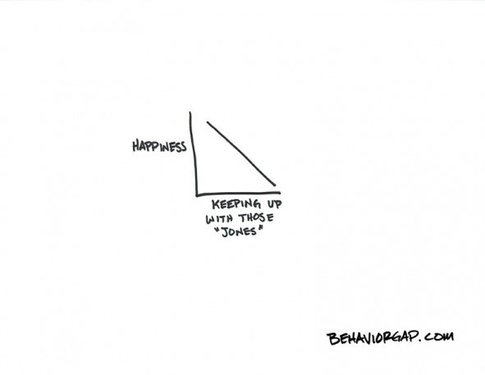
Given the addition of twins and my choice to stay home, most
months find us juggling bills, making tough financial decisions and waiting for
miraculous provision in one area or another.
Recently we overspent in the beginning of the month, which made the end unbelievably
tight, so I vowed to “get by” on what we have.
This included, among other things, not buying tissues. Given the
number of allergies in our house and the propensity for every cold within a
five mile radius to tear its way through all six members of our household, this
would prove to be no small feat.
So we’re in the great tissue spending freeze and I’m pulling boxes from all around the house and vehicles as we slowly work our way toward a long awaited payday.We’re down to one box now and I’m hoping it’ll somehow multiply like the loaves and the fishes or the widow of Nain’s jars of flour and oil. This isn’t the first time I’ve done this sort of thing – one time I decided to stop buying
soap until we’d used up every last drop in the house, including the oatmeal bars we made ten
years ago, the random gifts of body wash from my second baby shower, and the
tiny bars of Dove snatched from the free samples basket at the pediatrician’s
office.
I’m prone to fret and fuss about money. I hide it, count it obsessively, and shuffle it
between envelopes and jars, storing up for times of need. So when I see people who I know have quite a
bit more money than we do still complaining, worrying, and fretting about money and
life in general, I find myself thinking, “What can you possibly have to
complain about?” At times like that I have to refrain from
blurting out unhelpful things like, “Are you kidding me, we can’t
even buy tissues!”
God dealt with me on this awhile back, this belief that
somehow things would be easier, that life itself would be better if only we had
more money. It had become a real issue
for me, breeding bitterness, jealousy and envy that threatened my relationships
with those I perceived as having more.
God spoke to me one weekend as I sat in a friend’s new home and listened
to the unhappiness there, the fear and anxiety that weren’t so different from
what I knew. It was one of the few times
when God has spoken so clearly to me and the message was, “Kelly, you wouldn’t
be any happier if you had more money. ”
I told this to my husband as we drove home and I felt set
free, delivered from envy, delivered from the lie that money brings happiness.
* * * * *
While I was training to be a chaplain I learned to type up
and analyze conversations from my visits with patients and their families. Part of the analysis involved noticing what
myths the patient or chaplain were operating under during the conversation. It was often easy to tell which myths were driving the
conversation, which ones ruled over the patient’s life with a watchful eye,
delineating truth, establishing boundaries and taboos with unquestioned
authority.
We all have certain ideas that may or may not be true or
helpful, yet somehow persist in shaping our view of ourselves and the way we
ought to operate for things to go well in the world around us. Although many of the patients I spoke with,
prayed with and sat with were in crisis situations, it was also clear that much
of their personal emotional anguish came from their beliefs about the
world.
It may sound Pollyanna-ish, but attitudes and beliefs are
often at the heart of our happiness and misery.
The things we believe about ourselves and the world, especially those
that migrate slowly, gaining speed, from our hearts to our mouths and out into
the air around us, hold great power over our lives.
* * * * *
God delivered me from the myth that money brings happiness,
for awhile anyway. But recently,
visiting friends again, I found myself slipping, judging those with more,
lacking compassion for their deeply felt fears and anxieties because I felt
that the fact that they had more than me should solve the problem. Internally I argued, reminding myself I’d
been set free from the myth, but I could feel myself waffling, could feel my
compassion and my own capacity for joy constricting.
Then we came home.
Home to our cramped quarters, littered with toys and socks, divided by
wobbly gates to keep the twins safe, home to our emptying refrigerator, to our
last box of tissues and I felt the tug of that old lie more fiercely yet. I pushed back on it, though, and tried to remain
centered in the truth until the moment when my husband turned on our PC.
The computer wouldn’t start, not in safe mode, not in
regular mode, not in any mode. We ate
dinner and got the kids to bed and ran a test that revealed the worst – the
hard drive was shot, dying, dead. Then,
oh my, did that old myth ever get loud.
It rolled its way round and round in my thoughts
gaining speed, gaining momentum, gaining power as I gave in to exhaustion and
frustration.
Then, in the quiet of looking for candles and flashlights to
see us through hurricane Sandy, in the preparations for having, making-do with
less, I heard that voice again only this time it said, “Everyone feels this
way.”
Everyone feels frustrated, overwhelmed, powerless when their
computer crashes. Everyone feels like
they ought to know more about it, ought to be able to, with money, control that
which they cannot. It helped me to see
that the way I was feeling wasn’t due to a lack of money, but rather a lack of
control in my particular situation.
I’m writing this because I don’t want to forget, don’t
want to slip back into that old lie about money and happiness and I have a hunch I’m not the only one
who’s fallen prey to it. For me, the disciplines of presence and thanksgiving play a large roll in helping me to remember and remain rooted in the happiness and beauty of the life I do have.
Do you find yourself giving in to the myth that money brings happiness? If so, how do you overcome it?
Great Tissue Spending Freeze Update: Just the other day I got ten boxes of Kleenex “for cheap” at the local bent and dent store. I guess we’ll really be living large now, blowing our noses whilly-nilly, without a second thought, just for the sheer fun of it. Crisis averted.
A Chain That Lifts Us (a family activity and FREE GIVEAWAY)
I could blame the fact that Halloween and the days that followed were filled with the planning and execution of an unexpected trip to North Carolina. Or I could blame the jolting shift to daylight savings time which has the twins waking at five in the morning and my husband and I struggling to stay up later than the older two. I could blame the virus that ran through the house, having its way with us, or the endless loads of laundry and trips to the grocery store, but no matter how I look at it, we’re behind.
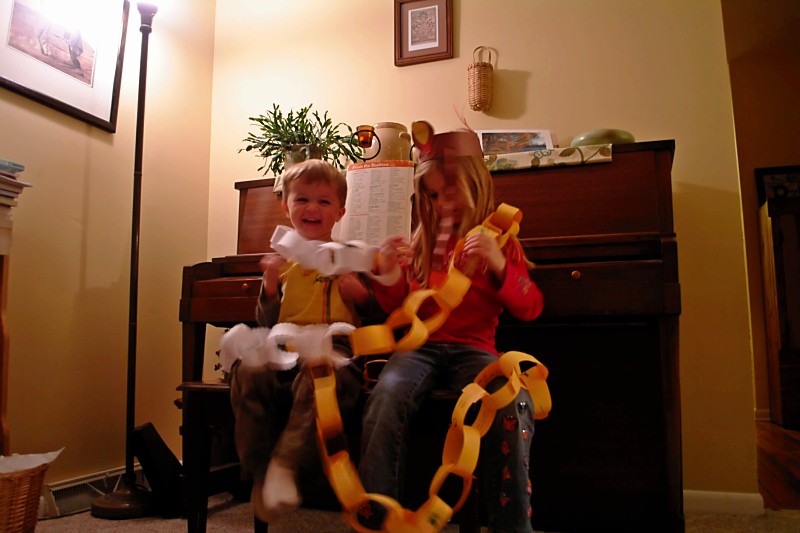
Every year for the past three we’ve commited the month of November to the practice of giving thanks. Each night after the dishes are cleared, we pass out slips of paper and put our hands, our minds, our hearts to the task of writing or drawing something we’re thankful for. Then we staple each slip into a circle creating link after link on a chain.
In this way we commit ourselves to growing in gratitude and there have been years, like the one in the picture above, where the chain has stretched clear across the living room.
When I first heard the idea I grabbed on to it like a life preserver. I was just beginning to understand the roll that gratitude might have in my life, the way it frees me for hope and joy, the way it stares defiantly in the shadows of fear and anxiety and the way it eases the endless battle between control and resignation that crowds my mind on any given day.
Too often I’ve arrived at Thanksgiving distracted, unprepared and tried to conjure thanks through guilt. “Well,” I’d tell myself, “I ought to be thankful.” So I used guilt to badger a weak, limping gratitude from my distracted heart. It was a celebration that fell flat and I was relieved to move on to the distracting demands of Christmas.
As a parent, though, I didn’t want my kids to come to Thanksgiving empty, because a meal, no matter how well prepared, can never fill an empty spirit. So we started practicing. There are no rules, no limits, except that everyone has to list something every night. On Thanksgiving, before or after the meal, we all sit around the table and read the slips, taking turns guessing who wrote what, reminding ourselves of our filled souls even as we feel the weight of our full stomachs.
Like I said, though, we fell behind this year. Yesterday started with crying babies at five a.m. and the house was a mess and as we cleared the table last night, as we faced the dishes and baths and waited for the twins to stop fighting sleep, I had to admit that I simply didn’t want to practice the discipline of gratitude. I wanted to hold on to my list of complaints, hold on to the hope of controling tomorrow. I didn’t want to surrender to grace even if my resistence meant starving my soul.
Thankfully, though, I have children, and their eagerness often draws me along forcing me to let go, forcing me to surrender what I would not naturally. So we sat, settled down to that moment of acknowledging what we’d received and I wrote, “I’m thankful it’s almost bed time.” My spirit lifted just a little, so I added, “I’m thankful for the right to vote and for homemade apple-pear sauce and spaghetti sauce.”
I wrote my son’s list for him and watched while my daughter ticked off a list of five things, one for each finger on her hand. Our four year old helped with the stapler and my daughter asked, while still writing, “What’s this called again? A chain of what?”
“A Thanksgiving chain,” I said, “a chain of thanks.”
As I spoke my son stood thinking and looking at the links we’d already added, the words on paper that held us together, that promised to grow and stretch in the days ahead.
Pressing on the stapler, looking at that feeble collection of papers and words, he said, “It’s a chain that lifts people out of the bad, right Mama?”
I recognized the truth as soon as he spoke it. A chain of gratitude, a book of thanks, a journal of a thousand gifts, seems foolish, weak and insignificant, but my son’s right, it’s a chain that lifts us, a chain that lifts me, out of the worst of myself.
“Yes, Solomon, that’s right, it’s a chain that lifts people out of the bad.”
I don’t know about you, but I know I need to be lifted. Lifted out of fear, out of anxiety, out of the tantalizing pulls of control and resignation, lifted onto the sure ground of the gospel which declares that all we have is gift, which confirms that for freedom we have been set free, that compells us to serve the greater good of love, even when it appears to be foolishness.
In giving thanks we’re lifted, repositioned, into joy and hope, which may not sound like much in the face of the world’s ills, until we realize faith, hope and love are always the starting point for every good thing. When we start and end our days with thanks, with faith, hope and love, there’s no telling where tomorrow will take us.
I’d love to hear, how does your family celebrate thanksgiving? What are you thankful for right now?
The first five people who comment will receive a free Chain of Thanks packet to help get your family started. If you’d like this free gift, please make sure to leave your email address so I can contact you to arrange delivery. It’s never to late to start giving thanks!
Inherent Unmarketability (why the gospel gets so few votes these days)

Inherent Unmarketability
How do you make attractive that which is not?
How do you sell emptiness, vulnerability and non-success?
How do you talk about descent when everything is about ascent?
How can you possibly market letting-go in a capitalist culture?
How do you present Jesus to a Promethean mind?
How do you talk about dying to a church trying to appear perfect?
This is not going to work
(which might be my first step).
Richard Rohr in “Everything Belongs”
The Grouchy Ladybug (How I Died a Hundred Deaths this Halloween)

(this should be a cute picture of my son and I in our costumes,
but that’s another longer story for another day)
It’s rainy and cold and we’re all keyed up and worn out from being trapped indoors for two days by
Hurricane Sandy. I wake up, too late,
and squeeze in a shower while the twins, still in dirty diapers from the
night before, wander around the living room. Their whining amplifies to full
pitch as my shower cues them in to the possibility that I’ll be (gasp!)
leaving for the morning. The preemptive
separation anxiety continues through breakfast and packing everyone into the
van to take my oldest to school.
After drop off I cart the remaining three kids back
into the house. We mull around, waiting anxiously for the babysitter
who’ll be staying with the twins while the four year old and I head to his Halloween party at a local nursing home, an event I’ve been dreading since the October calendar came home. The twins settle for a few minutes,
their anxiety lulled by the fact that I haven’t left at my usual time and almost simultaneously my son’s anxiety about the party begins to rise. He peppers me with questions,
“Will there be people from the nursing home in the party?”
“Um, I’m not sure, honey.”
“Will they see me in my costume?”
“Yes.”
“Are you going to dress up?”
“No”
“I don’t want to wear a costume.”
I’ve been “against” this party from day one and I know that my son, so robust
and cheerful at home, will be shy and clingy in a new place. So I’ve consented to hire a babysitter
for the twins and am committed to accompanying him, despite my own teeth-clenching,
foot-dragging antagonism toward it all.
“Solomon,” I say, “what if I wear a costume too?” I emerge from the back room wearing the
fuzzy black antennae from my daughter’s ladybug costume.
“Ok,” he says, brightening, “you can be a black beetle.”
Then, I can feel myself giving in, letting go a little more
as the idea strikes and I say, “What if I’m a ladybug? I can steal Sophia’s costume.”
He approves and I have just enough time to gather the
red and black-dotted wings and my camera as the babysitter arrives and the oldest twin
dissolves into a raging stream of tears, protesting my impending
departure. I run in circles grabbing
things, carrying the littlest one and nearly run out the door with him, before
the sitter stops me and grabs him saying, “This one’s staying.”
Then we’re off to a party I don’t want to go to, but also
don’t want my son to miss. We drive
through the rain and find his friends in a large room coloring at a
table while elderly people in wheelchairs are set in a wide circle around them. The residents watch, their eyes hungrily absorbing the beauty and innocence, the luxury
of so much youth in one small space.
My son is clingy, shy and tired, overwhelmed, it seems by
the noise, the crafts, the games and I do my best to get into the spirit of
things. I help with glue and tear bits
of tissue paper, I assure another child that it doesn’t matter where he puts
the eyes on his pumpkin. I laugh with
the other Moms over the resident who rides in on a wheelchair, pretending to
scare the kids with a mask, all the while giving a growing peep show as his
robe slides further and further open. I take a smiling picture with my son, a little Iron Man snuggled up on a ladybug’s lap.
By the time we get home, though, I’m over-stimulated and frustrated at my
inability to love Halloween, to love loud parties and candy. The twins are exhausted and hungry when we walk in and they’re
drawn to me like magnets, pressing their tiny bodies onto me in
desperation. It’s all I can do to
untangle myself, causing more tears and desperation, as I head to the kitchen to
make lunch. Solomon is sorting and
dumping candy, dancing and singing and blowing the whistle from his party bag
and the twins are screaming in their highchairs, desperate to make it clear how
deeply my absence has wronged them.
Then I’m yelling, “Stop it” and throwing an apple-peel all
the way across the kitchen til it bounces off of one twin and they both sit
staring, shocked into silence and my son, that sweet four year old boy, offers
to play his whistle to settle them down.
* * * * *
There are days when being a mother feels like dying a hundred tiny deaths. A hundred letting-gos, a thousand surrenders to more noise, more movement, more demands than I feel capable of handling.I’m not complaining, I simply want to be honest about the stretch of motherhood and how quickly, how fiercely, I shrink back from it.
I died a hundred little deaths this morning and will surely
die a hundred more before nightfall on this, the day of the dead. But I know, thank God, that this dying, this
surrender makes me new again. I may die a
hundred times a day, but I’m just as often made new, reborn in the face
of a chubby, gap-toothed grin, a gentle hand seeking mine for reassurance. Just today I was resurrected
by the voice of my son calling cheerfully from the back of the van as we made
our way home, “I can’t wait to be old so I can go to the nursing home to live.”
* * * * *
Later in the day as I’m making chili for friends who’re coming to trick-or-treat with us, as the twins again stand whining at the gate that divides them from me, my Dad calls with the news that my maternal grandmother has died in the nursing home where she’s lived for years now in North Carolina. As I stand over the stove, stirring the chili, I find myself surprisingly grateful. Grateful that, though I couldn’t be there with her, I was here, at a nursing home with my son, the very same morning. I think of my Grandmother’s life and the many little and big deaths she endured. I think of the ways I get so focused on what I’m giving up, that I nearly miss what I have right here, right now in front of me. It occurs to me that I live such a grace-filled life, full of opportunities
for surrender, continually pressing me toward the edge.
Dinner is finished, the kids and husband are home and the poor older twin, who just can’t pull himself together, sits crying on the floor. So I scoop him up and settle in the rocker and watch as he drifts into a heavy sleep. I love the moment, the rocking, the sleeping child, so rare, then he lifts his head and looks around disorientedly before throwing up all over both of us. Then he leans forward, laying his head back on my chest with that pile of warm, smelly goo laying like a layer of glue between us. I died again in that moment and rose again to hug him tight until my husband came to help us both get cleaned up.
Every day of the dead, every Halloween, gives way to all saints
day and I wonder if we too, dying in our little and big ways, aren’t also being moved, continually,
from death to new life. This dying is a surrender, a stripping bare by letting-go until all that remains is love.
Lightship (wind and rain and holding your place)

What can I say except that, as a mother of four, I spend inordinate amounts of time reading children’s books and quite often I hear God’s gentle quiet voice speaking to me through them. This keeps me convinced that God will use whatever medium available to speak to us! In light of hurricane Sandy’s approach, I thought I’d share a favorite with you, Lightship, by Brian Floca.
Lightships were used in places where a permanent light house couldn’t be built. The ship and crew “held their place” during good and bad weather to serve as a guide to other ships. Something about the lightship’s calling deeply resonated with me and my sense of calling.
In the past year, since the twins were born, my spiritual images have been filled with boats and water and floating – sinking and swimming became a metaphor for trust as grace has begun to feel like an ocean that surrounds our every waking moment. For me, the spiritual journey has become one of learning to let go and rest in that grace.
So here it is, minus the glorious pictures (check it out at your library if you get a chance – it also has a great section on the history of light ships).
* * * * *
Lightship, by Brian Floca
Here is a ship that holds her place.
She has a captain and a crew,
helmsman, oiler, engineer
deckhand, fireman, radioman,
messman, cook and a cat.
She does not sail from port to port.
She does not carry passengers or mail or packages.
She holds to one sure spot as other ships sail by.
She waits.
Her crew lives in small spaces, works in small spaces.
Always there is the smell of the sea . . . and the rocking of the waves.
Always they hear the creaking of the ship and the slow
slap, slap, slap of water on the hull.
Down below deck,
deep inside the ship,
there is the smell of fuel and machinery.
There are motors, engines, generators.
The oiler and the engineer keep them clean and running.
They keep the whole ship powered.
Above the deck there is a horn.
High on each mast there is a light.
The crew keeps them ready.
The higher the waves,
the harder the work;
the harder it is to climb the stairs,
to check the charts,
to drink the coffee,
to visit the head.
But the crew keeps the lightship anchored.
She holds her one sure spot.
They keep her anchored in sun and calm . . .
and snow and cold.
They keep her anchored when other ships
come closer than they should.
And if the waves move her off her mark,
. . . the helmsman moves her back.
The crew resets the anchor.
Again the lightship holds her one sure spot.
She does not sail from port to port.
She does not carry passengers or mail or packages.
She holds to one sure spot as other ships sail by.
She waits.
And when the fog
comes creeping in,
the crew knows what to do.
They sound their horn, so loud the whole ship
SHAKES
BEEOOH!
They shine their light,
so bright
it reaches all around,
far and wide.
Then other ships sail safely,
because the lightship marks the way
through fog and night,
past rocks and shoals,
past reefs and wrecks,
past danger.
Other ships sail home safe . . .
because the lightship holds her place.
* * * * *
When storms come and the fog rolls in we all need something or someone to shine light on our path, something or someone to hold us to the course we were made for. Tonight, as the winds surge and rain pounds I wonder, who or what is holding you?
Praying you will remember and hold tight to the One who anchors your soul. May your life shine like the Lightship and may others “sail home safe” because you hold your place.
If you want to read more about learning to let go and float in the ocean of grace, check out Learning to Float (lessons in the art of surrender).
This link is being shared with Imperfect Prose around the theme of “Light.”
When I Found Out I was Having Twins (a little somebody and . . . maybe another somebody?)
When I found out I was having twins,
I laughed, like Sarah,
“Me, God? A mother of four?
Surely you must be kidding!”
When I found out I was having twins,
I questioned the angel, like Zechariah –
gave him a good ol’ lecture about the birds and the bees,
about all that is and is not possible.
When I found out I was having twins,
I accepted, like Mary,
the blessing I was given –
“Let it be unto me,
according to your word.”
God’s always, always, always full of suprises. I’d love to hear how God has suprised you. How did you react – did you laugh? cry? question? . . . feel free to leave a comment here or on A Field of Wild Flowers on facebook.
If you like this post and want to read more about my journey check out: The Blessing.
Silence (of headaches, libraries and boats)
“There is a
castle on a cloud,
I like to go
there in my sleep . . .
Nobody
shouts or talks too loud,
not in my
castle on a cloud.”
from Les
Miserables
Today is a
headache day. It’s there from the moment
I wake up – pressure in my forehead and sinuses that extends around to the back
of my head into my neck and shoulders.
When the
babysitter comes I’m sitting on the floor surrounded by wiggling people. I’m trying to wrestle a onesie onto a baby as
my pre-schooler performs gymnastics half-on/ half-off of the couch. The oldest is bopping back and forth on the
rocking chair as another baby teeters trying to hold onto it. My head’s pounding and I can’t think
straight, can’t make a plan.
When someone
asks where I’m going, I have no reply because I haven’t thought that far
ahead. I only have about an hour and a
half before I need to round everyone up for swim lessons. I grab the laptop and my journal and make a
quick exit, stammering instructions as I leave.
No one even gets a hug. Mommy has
got to go, NOW.
I picture
neighbors or the drivers of passing cars looking up to see me flying out the
door, hair frizzed-out from the heat, clutching my gear as the twins crawl
after me and Solomon stands at the screen door calling a cheery, “Bye bye Mamma. Bye!”
I imagine I look like someone fleeing a burning building as I throw my
things into the van, pop it into drive and squeal-out not yet knowing where I’m
going.
I head to
the local college library, not more than a few blocks from our house. I can maximize my time this way, by not
driving across town to Panera or a local coffee shop. Every second counts.
I find a
nice parking spot right in front of the library. It’s beautiful here. Tall, old trees, fully leafed out for
summer. A fresh green lawn and the
beautiful library full of windows and light and silence.
I feel
better even as I open the door to walk in.
It’s cool and quiet with the humming of the air conditioner providing a
steady pulse under it all. I head past
the café where a sign explains that turning left will lead to a “semi-quiet”
area, while turning right leads to pure silence. I turn right and follow signs toward the
quiet area like a starving person follows a path of crumbs.
The headache
is still there, but the effect of the silence is immediate. It’s like aloe on sunburn, cool and smooth,
calming. It’s as though some part of me
that’s been holding its breath relaxes and lets out a long, heavy sigh.
I’ve always
needed this sort of retreat, always felt this way about libraries, academia and
books, using them as a refuge from the intensity and volume of life. I remember
meeting with a professor when I was in graduate school. His office was on the top floor of an old
brick home on the edge of campus that was used for faculty offices. I climbed narrow stairs covered by faded and
decidedly un-prestigious old carpet to a large attic-like room. Two more stairs and through the door and
there sat his desk with a large window behind it filled with the leafy green
branches of a tree. I imagined myself
sitting there – reading, writing, pausing to peer out at the world below – and
I loved it.
Not long ago
a seminar revealed that my personality type uses cognitive activity as a way to
recharge and regroup. An observant
friend noted the same thing after listening to my life story, “You retreat into
your mind when life gets overwhelming.”
Suddenly I saw the Sudoku and crossword puzzles, the endless reading,
the love of libraries and their contents in a new light.
I used to
feel very torn between academia and the nitty-gritty of everyday life. The ivory tower is much maligned by those
working in the trenches and I’ve often found myself vacillating between the
two. I don’t believe in the value of
what some would call pure academia cut off from the ebb and flow, the flux and
tumult of everyday life. I refuse to
climb the staircase of my mind expecting to find there the answer to all life’s
questions. And yet, I love, enjoy, crave
the retreat it offers. The space it
gives to look at life, to sort through the onslaught of thoughts and feelings
that accumulate as I race along through the day.
I’ve often
felt guilty about this, even ashamed. I
was teased as a child about “hiding my nose in a book” and my need to spend
long hours quietly making order of my little room in our house on a hill in the
leafy woods. But more than all of that,
somewhere along the way I believed the lie that to be holy meant to be busy, to
be fully immersed in the hustle and bustle, the suffering and relief of life
without flinching or pausing to look away for even a second.
I can see
now that I will constantly straddle two worlds.
I’m not content to sit in my tower day in and day out thinking deep
thoughts – too many people need me in more ways than I can count. But I’m also beginning to understand that
times of retreat are essential to my ability to provide a real presence when I
engage with the “crowds,” whoever they may be.
Jesus did
this, of course. Retreating to a garden or
hill or even, if need be, to a small boat in the middle of a lake. Luke tells us that “Jesus often withdrew to
lonely places and prayed (5:16).” Surely
no one’s time and presence has been or ever will be more in demand than the son
of God.
* * * * *
It occurs to
me that I cannot steer my little ship full of children safely or wisely when
I’m constantly drowning. So, with much
grace, I re-imagine my departure from the house. I’m not a woman fleeing in desperation,
shaking off children and tripping on scattered toys as I lunge for the
door. Instead I try to see myself as
Christ, edging his way toward the shore and stepping with purpose into a small
fishing boat. Pushing off even as the
crowd presses in, hardly waiting for Thomas or Peter to climb in as the bottom
of the boat breaks free from the sand.
Leaving the chaos of the crowds for the chaos of the sea, but finding in
the tiny boat the space to simultaneously disconnect and reconnect.
The van is
my boat and the curb is the shore. The
library is my “secluded place” and this writing is my prayer. This retreat takes me not out of the world,
but deeper into it to the place beneath the wave tossed surface where love and
joy and grace reside. I paddle out deeper
into the cool dark waters to the place where I might find, we all might find,
the one thing that’s needed.
I wonder, where do you go to retreat, where do you both disconnect and reconnect?
The Second Presidential Debate and Who I’m Voting For
They came out like boxers in the ring, like two dogs in a back alley street fight, ready with a snarl, lips curled at the slightest hint of aggression, straining at their leashes. There were rules, as there often are, but each was prepared to ignore the rules relying instead on instinct and the ability to get ahead with a well-aimed, well-timed punch below the belt. They out-numbered, out-weighed the referee and even the audience. They believed the fight was theirs to win or lose, to make up the rules as they went. Who could blame them, really? So much was at stake. They came out, their pockets filled with stones, each hoping to bury the other.
In the balance, America sat like a juicy bone tossed on the ground between two dogs. Still, it wasn’t the bone the fighters cared about, but what it stood for, what being top dog would mean, things more elusive than a bone, things like power and control and ideology. But power and control and ideology rarely fill the empty stomach, rarely warm the family huddled together under layers of shabby quilts for warmth, and more rarely yet provide adequate answers to the deepest hungers, the deepest needs of the human heart.
So, as the fight grew, as the two circled, bobbing, swaying and throwing their stones, America walked away. She turned off the screen and laid awake filled with the adrenaline that comes from watching a fight, almost wishing for a chance to throw a punch or two, to take a bite out of something, someone. November sixth still promised the opportunity to have her voice heard, but there in the darkness of night, with the chill of winter creeping in, a different kind of cold, that of disillusionment and fear found its way through the door cracks and moved in through windows covered-over with plastic sheeting. America shivered and turned out the light, not knowing what tomorrow would bring.
* * * * *
As a parent, a homeowner, a citizen, I understand more fully now than ever before the importance of voting. In college and even graduate school my attitude toward politics veered between cynicism and naïve optimism. I cast my first ballot for Bush during his first term and then later voted for Kerry when Bush ran for reelection. I voted on a whim, I voted as a right of passage, a way of becoming an adult and distinguishing myself from my parents. I voted despite the feeling of futility regarding the outcome, despite not fully understanding the issues.
My attitude toward voting has changed in the last two elections. I can see now more clearly the cumulative effect of the decisions we make regarding the economy and the environment and foreign policy. I can see how a deduction here, a tax incentive there can place a family ahead or behind by several thousand dollars which can really add up for people who spend their lives in tens and twenties rather than trillions. I look at my children and wonder if wars are in the making now that will steal away the brightest years of their lives, of our lives. I can appreciate more deeply that how I vote matters, not just for me and mine, but for millions of other Americans, millions around the world.
At the end of the day, though, one will win and one will loose and in the span of four years progress will be made in some areas and grave mistakes will be made in others. We’ll all be back at it again in four years, gathered around our viewing screen of choice, carrying the baggage of four more years of hopes and dreams, four more years of life and death and everything in-between. We’ll be watching the fight, putting our money on whoever the top dog appears to be, hoping that some small fraction of the prize will be ours if we manage to vote well.
* * * * *
I came across a quote the other day that, for me, sums up the calling of Christ in us and, conversely, the problem with so many facets of Christianity today.
“If am not careful, I can decide that I am really much happier
reading my Bible than I am entering into what God is doing in
my own time and place, since shutting the book to go outside
will involve the very great risk of taking part in stories that are
still taking shape. Neither I nor anyone else knows how these
stories will turn out, since at this point they involve more
blood than ink. The whole purpose of the Bible, it seems
to me, is to convince people to set the written word down
in order to become living words in the world for God’s
sake. For me, this willing conversion of ink back to blood is
the full substance of faith.”
Barbara Brown Taylor in Leaving church: A Memoir of Faith
I love what Taylor’s saying here, “we are living words” and I wonder if I might stretch the idea a little further to say, “we are living votes.” Stay with me here for a minute. What I want to say is that we vote with our lives. It’s true that we come together every four years to vote and the decision we make is important, but we also vote every day with our lives – our time, our money, our words, our touch, and our deepening capacity to multiply love and joy and hope in the world or, conversely, our tendency to multiply fear.
So here it is, friends, I’m voting for YOU.
In truth, God votes for us; God voted for us in Christ and continues to vote for us still. Even as the disciples stood staring dumbfounded at the sky as Jesus ascended, the very words, “But, Lord . . .?” forming on their quaking, dry lips, even then I picture Jesus looking back at them filled with love, filled with hope saying in effect, “It’s OK, you got this, we’ve got this one.” God votes for humanity by instilling in Christ’s followers the very power of God that raised Christ. God votes for you every day, votes for the power of Christ in you.
Let me be clear here, lest this come across as some form of progressive optimism and faith in the ability of the human spirit to pull itself up by its boot straps. When I say I’m voting for you, what I mean to say is that I’m voting for Christ in you. Because, otherwise, let’s be honest, a vote for me or you would simply be another wasted vote. I know me and if you’re anything like me, we’re all still struggling to figure out what a boot strap is, never-mind pulling ourselves up by it.
I’m placing my vote for Christ in you, for that growing power of the resurrected Christ that now lives, breathes and moves in you. I’m voting for the power of Christ at work in the woman who just quit her job to help care for a sick family member. I’m voting for the man who’s working with the Mentoring Project to match positive male roll models with at-risk youth in our town. I’m voting for the power of Christ at work in a friend who faced down her fears of the unknown and traveled to Haiti and found a deeper calling to compassion and service through time spent cuddling a needy child. I’m voting for the many in my small church who’re slowly learning that where our potential ends, God’s begins and who are slowly taking leaps of faith in hundreds of big and little ways.
I’m voting for the power of Christ at work in a woman I baptized not long ago who’s trying to quit drinking and for single mothers I know and new moms who’re struggling to negotiate a balance between the desires of career and home. I’m voting for this silly sale of dresses to benefit displaced Syrians and for my kids who collected cardboard to feed hungry families and for Orange Korner Arts whose programs are bringing light and life and healing to inner-city Philadelphia. I’m voting for my neighborhood that, like so many others across America, is sitting on the edge in need of a healthy dose of light and life and hope.
I’m voting early – I’ll be there on November sixth, but I’ll be voting every day up until then and every day after too. I’m voting every day from here on out, voting with my life, my faith and trust. I’m voting for me and for you and for Christ in us all, because I understand now more deeply than ever that every vote matters.
Maybe if we all keep voting every day from now until the next election, we’ll find that it matters a little less which two dogs we have to bet on, matters a little less who the winners and losers are, because we will have voted, with our lives, for the power of Christ at work in the world, the only One who has the power to heal, restore and redeem us all.
Reading Rilke in the bathroom, this is what the things can teach us . . .
I first encountered Rilke in seminary. His book, Letters to a Young Poet, was required reading for a class I took on the sabbath, though the connection between the book and the topic completely eludes me at this point. The introduction told of his bizarre childhood and how his mother, in her grief over the death of a daughter, dressed and raised him as a girl, calling him by his middle name, Maria, until the age of six. At ten Rilke’s father sent him off to attend a military academy for which his temperament was ill-suited and where he endured intense bullying and loneliness.
My copy of this little book is filled with underlining and dog-eared pages. At some point I loaned it to our friends (the some ones we used to share a TV with, but more on that in another post) and they kept it on a little shelf in their bathroom, almost as a decoration. One of my favorite quotes from that first book holds sage advice for the life of the spirit,
“Be patient toward all that is unsolved in your heart and
try to love the questions themselves like locked rooms
and like books that are written in a very foreign tongue.
Do not now seek the answers, which cannot be given you
because you would not be able to live them. And the point is,
to live everything. Live the questions now. Perhaps you will
find them gradually, without noticing it, and live along some
distant day into the answer.”
Later I was introduced to “Rilke’s Book of Hours: Love Poems to God,” by a woman I was meeting with for spiritual direction. I’ll confess that I was impressed with the idea of the book and thought it lofty and impressive reading, so I ordered it quite quickly from amazon. I was disappointed when it arrived. First off, it had those annoyingly uneven edges that are meant to lend an air of artistry, I suppose, but otherwise make a book impossible to flip through. Also it failed to transform me into a more interesting or insightful person over night, though I did think that, with its rough cut edges and delicate silvery cover, it might be just the right kind of book to leave laying about for company to see (insert sly smile here).
I now keep it tucked away in my room on my bedside table or sometimes in the upstairs bathroom so it’s there waiting for me when I flee the tumult of life with four kids for a brief time out. The poems have grown on me over time and I’ve found bits and pieces that speak into whatever questions I find myself facing.
Just the other day I came across the poem below while hiding in the upstairs bathroom. It makes an nice followup to my previous post on the implications of God’s work in creation and leaves me with much to think about, so I thought I’d share it. This poem is from the middle of the book in the section titled “The Book of Pilgrimage.” It’s listed as poem II,16.
How surely gravity’s law,
strong as an ocean current,
takes hold of even the smallest thing
and pulls it toward the heart of the world.
Each thing –
each stone, blossom, child –
is held in place.
Only we, in our arrogance,
push out beyond what we each belong to
for some empty freedom.
If we surrendered
to earth’s intelligence
we could rise up rooted, like trees.
Instead we entangle ourselves
in knots of our own making
and struggle, lonely and confused.
So, like children, we begin again
to learn from the things,
because they are in God’s heart;
they have never left him.
This is what the things can teach us:
to fall,
patiently to trust our heaviness.
Even a bird has to do that
before he can fly.
Beautiful Things (a grain of sand, a bit of bread and wine, and we are recreated)

Magnified images of single grains of sand taken by Dr. Gary Greenburg
I came across this beautiful picture a few weeks ago in a magazine I picked up at the library. It turns out sand isn’t brown or “sand” colored at all – holding a handful is like holding a rainbow as each piece is composed of tiny pieces of coral, lava and shells, among other things. Isn’t it crazy, so much beauty right in front of us, beneath us, clinging to our clothes and sticky kids, pouring out of our shoes and socks every time we stand at the ocean’s shore – all of these tiny, broken bits of beauty right on the edge of all that chaos – who could imagine such a thing?
* * * * *
I spoke at my church last Sunday on the Doctrine of Creation and the whole talk consisted of two simple points regarding what it means to say we believe in “God the Father, Almighty, creator of heaven and earth.” First, God is CREATIVE and second, this gives us HOPE.
The God we find in Genesis 1 is too creative to look out over the dark primordial chaos and say, “Yeah, I ain’t got nothin’ to work with here.” Instead God looks and pauses as a smile starts to spread and the creative juices get flowing. All that nothing gets God thinking, imagining and soon all that’s good is flowing out of his words, out of the same wide-smiling mouth of God.
The fact that God is creative tells us that dust and darkness and death are never what we fear them to be. Some of the most beautiful people I know are the one’s who’ve been most deeply broken by life, but who cling to and allow their belief in God’s creative power to recreate them. They, like the trees and rivers and mountains, become living, breathing proclamations of God’s creative power. Gungor’s song, “Beautiful Things” says, “You make beautiful things out of the dust, you make beautiful things out of us.” What if we really believed this? What if we believed God sees more than dust and darkness and death when he looks at us, when he looks at our world? What if we started seeing this way too?
This past Sunday we practiced our hope by writing the areas of our lives that need to be recreated on slips of paper and burying them in a sandbox as we came forward for communion. Silly, right? We all know nothing much grows in sand and that a little bread dipped in wine is just that. But the invitation remains to see beyond the chaos, the darkness, to trust in the One who causes streams to flow in the desert and transforms bits of wine and bread into that which promises to transform us all.
We swallow the bread, we sip the wine and something new begins to spring up through the dry, dusty cracks of our lives – we are being re-created. Hope begins its work in us – the hope that things are more than what they seem, that even here, even now, the creator God is speaking goodness into being.
I know it’s hard. Some days I could swear that everything I see is covered with dust, layers of brokenness, layers of not-good-enough and never-amount-to-nothing-ness. The world seems so entrenched in its deadly ways and I choose too often to linger in the valley of the shadow of all this death; choosing life comes hard and often flies in the face of rationality. Sand is just sand after all and we do our best to shake it off and move on.
The world we live in is starving for hope, for something to believe in, that’s why we fight so hard for our little brands of right and wrong, for anything that promises power and control. Maybe, though, if we were to look through the lens of Christ we would find that everything we’re waiting for, longing for, has already begun, right here in the midst of us. The mystic poet Rumi says,
“Out beyond ideas of wrongdoing and rightdoing,
there is a field. I’ll meet you there.
When the soul lies down in that grass,
the world is too full to talk about.”
Maybe the world isn’t a battlefield of data and sound bites, an endless round in the race to control and interpret information. Maybe it’s a field full of wild flowers sprouting up defiantly, daringly in the midst of all this chaos and darkness – can you make the time to see them? There’s one at your feet just now, waving and swaying in the sunlight, exuding the scent of life and hope and love that overcomes fear.
Or maybe the world is a sandy shore, a million pieces of beauty and light laying there beneath our feet. Can you see it? “Lay down here on the shore,” God says, “Let your body rest, here, in the sand. Let these millions of pieces of broken beauty hold you until you can see them, feel them for the truth they are; until you can see yourself for the broken bit of beauty you are. Let the water wash over you, don’t be afraid of the chaos. I’m creating you anew, even here, even now.”
Leaning Into the Space Between (of Gliders, Covers and Computer Chairs)
My husband and I have been known for our quirky household habits. We’re not big on cleanliness and our home organization system is highly intuitive at best. For example, early in our marriage we kept our microwave in a cupboard which meant we had to get it out any time we wanted to use it. It was a hulking thing, tan and brown with a knob for setting the time, no fancy buttons or stainless steel. I think we were trying to conserve countertop space while also being embarrassed by how it looked, but even we had to admit that keeping a microwave in a cupboard ate into the efficiency of its use. Plus sometimes one of us would forget to put it away and the other would say, “Ok, who left the microwave out?” and saying it out loud made it sound pretty silly.
Quirkiness is expected at our house and lately I’ve noticed a new habit – we’ve started getting rid of things we need before we have their replacement. For example, we had two ancient glider rockers in our living room for a long time. As an introvert at home with four children, I grew to hate those chairs; the added motion of one or another of the kids constantly bopping back and forth on them was often a tipping point for me in terms of outward stimulation. This summer we sold the oldest rocker at a yard sale thinking we’d surely make enough to be able to find some “new” seating on Craig’s list. The rocker sold for $4 after my husband was bargained down from the $5 price tag we had on it. Not exactly enough to buy a replacement, so we went several weeks without enough seating in our living room. This made for an awkward situation when guests came and we all crowded together on the couch or I crouched nonchalantly on the living room floor.
More recently, when our computer chair broke, but was still usable, I hauled it out to the curb. I now sit typing in the other glider rocker, which has become our computer chair, which means that when we watch shows on the computer (sold that TV at the yard sale too) one of us sits in the glider while the other hunches in a little wooden chair borrowed from the kids’ room.
Eventually we’ll make our way over to Staples to buy a new chair or find one on Craig’s list. In the meantime I’m beginning to enjoy the space created by letting go of things before we know what will take their place. There are other areas in my life, too, where I see this happening, where the no’s are coming more easily, where there’s more trust in the open space, the yawning divide between commitments.
I had an on-line conversation with a friend recently who said he was “learning to trust.” I replied that maybe “leaning into trust” would be a more surefire approach; circumventing the rational process of “learning” and replacing it with well-timed free-fall into the arms of the One who catches us. I know not having a computer chair is a small thing in a world where many don’t know where their next meal’s coming from, but I have to wonder if even these little leanings aren’t somehow helping me learn to live and lean more freely as though the net that catches me each time is as sure and wide as the Father’s love for us.
There’s a segment in the video, Home At Last where Henri Nouwen talks about his interactions with a trapeze group he followed and observed for a period of time. Here’s what Nouwen has to say about the group,
One day, I was sitting with Rodleigh, the leader of the troupe, in his
caravan, talking about flying. He said, ‘As a flyer, I must have
complete trust in my catcher. The public might think that I am the
great star of the trapeze, but the real star is Joe, my catcher. He has
to be there for me with split-second precision and grab me out of the
air as I come to him in the long jump.’ ‘How does it work?’ I asked.
‘The secret,’ Rodleigh said, ‘is that the flyer does nothing and the
catcher does everything. When I fly to Joe, I have simply to stretch
out my arms and hands and wait for him to catch me and pull me
safely over the apron behind the catchbar.’
‘You do nothing!’ I said, surprised. ‘Nothing,’ Rodleigh repeated.
‘The worst thing the flyer can do is to try to catch the catcher.
I am not supposed to catch Joe. It’s Joe’s task to catch me. If I
grabbed Joe’s wrists, I might break them, or he might break mine,
and that would be the end for both of us. A flyer must fly, and a
catcher must catch, and the flyer must trust, with outstretched
arms, that his catcher will be there for him.’ (emphasis mine)
I can’t watch that clip, listen to Nouwen’s excited commentary, without tearing up. Nouwen goes on to say that he used the image at a friend’s funeral as a picture of the surrender in death. It’s a beautiful image, but if death is indeed a surrender, then might not life also be an on-going rehearsal, a moment by moment opportunity to practice the art of surrender – the art of leaning, falling, trusting the open space, stretching our arms even before we see the One who waits to catch us?
Last night as we went to bed we were forced to admit it’s beginning to get cold; it’s time for a warmer blanket. The funny thing is, as we lay their accepting the change of seasons, moving into the newness and familiarity of fall, it dawned on us both that we’re pretty sure we threw out our down comforter last spring. It was old, stained, and the down was forever winging its way toward the edges, leaving us thinly covered, shivering in the middle, so we tossed it in a fit of cleaning and ambition. It was time, that’s for sure, but here we are in mid-October snuggled together for warmth under a thin coverlet.
The handle of the door on the van came off in my hand the other morning, the oldest has outgrown all her shoes, and our wardrobes are wearing thin. All of this to say, a new comforter isn’t really in the budget. But, it’ll work out somehow. In the meantime we’ll enjoy the excuse to cuddle close.
I’m starting to enjoy the wide open space between letting go and being caught, to lean into the in-between, into the small discomforts of waiting and needing. One thing I know for sure is that these spaces – the spaces made by our letting go, the wearing thin ones, the crowding together on the couch or floor ones – are the ones that open us to the possibility that we’re learning how to fly. “A flyer must fly, and a catcher must catch, and the flyer must trust, with outstretched arms, that his catcher will be there for him.”
A Day in the Life (with Twins)
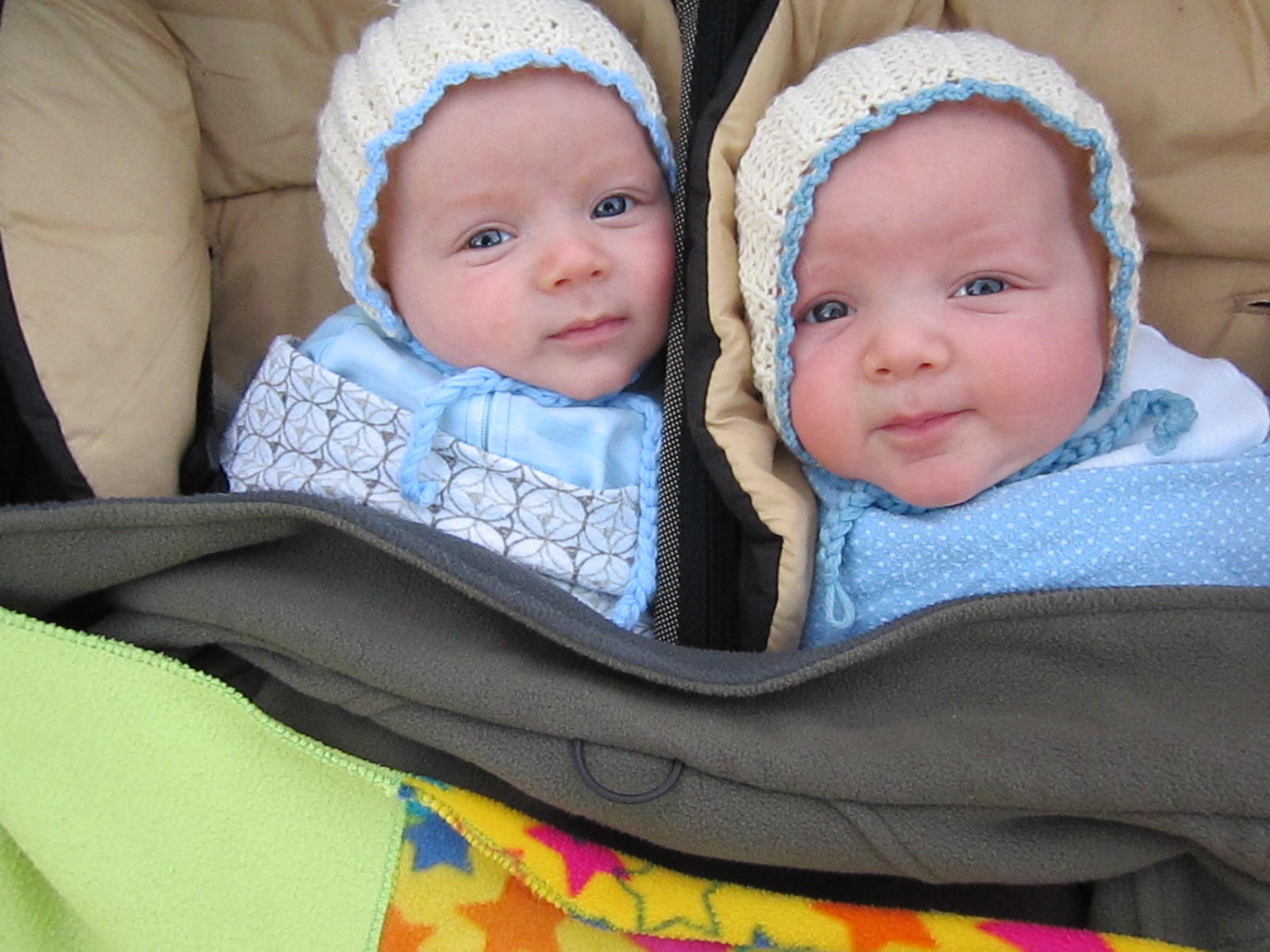
Our boys in their sweet little handmade bonnets about a year ago.
Pretty much everyone I know has said at some point in the past year, “I don’t know how you do it.” By “do it” I assume they mean manage the day-to-day needs of a family of six while still managing to, ocassionally, show up in public wearing clean clothes. One of the ways I’ve found to cope with the intensity of parenting four children five and under is to step outside of the situation and observe things with a sense of humor or absurdity. This skill provides plenty of facebook fodder and continues to help me get through the nitty gritty of life with two one-year-olds.
In honor of my friends Tom and Sarah who welcomed twin girls on Monday (whoot!), here’s a glimpse of my life last fall, when the twins were about two months old. It was a typically intense day and I decided to “enjoy” it by recording how simply absurdly chaotic things were. For the sake of clarity, the twins are Levi and Isaiah, and Solomon was four and Sophia five (and now that you know my children’s names, I will probably have to kill you!).
4:21 (am) Wake up and try to think of ways to get John to get up and give Levi a pacifier. Look at the clock and realize the twins have slept 6 hours;I guess we need to feed them. Get up and nurse the babies, change their diapers and nurse them some more. Ask John to set the alarm for 6:30 so I can get up before the kids. Ask John to set the alarm again because I can’t remember if I asked him yet.
6:30 Wake up with the alarm, think I’m hitting snooze and turn it off.
7:00 Wake up to Solomon calling on the monitor. Look for and find glasses. Turn off the monitor.
7:12 Wake up, with glasses in hand, to the sound of fussing babies and hear the older kids calling and banging on their door downstairs. Check on babies – still technically sleeping – then head to Sophia and Solomon’s room. Solomon says he’s sick and demands medicine – a brief fight ensues. Head to the kitchen for coffee and to warm up milk for Solomon. Groggily sit in the living room and beg-off of reading books until the caffeine can hit my system.
7:30 Read a book with the kids, find clothes for Yellow Day (Sophia) and Blue Day (Solomon). Get cereal for Sophia and a cereal bar for Solomon. Run up to check on the babies – give Levi a pacifier.
7:45 Pack Sophia’s lunch, write a note for Solomon’s teacher. Urge the kids to get ready. Remember that I need to take vitamins and cold medicine.
8:00 Grandpa comes to take the kids to school. Make two trips upstairs to bring the babies down. Nurse the babies and change 4 diapers. Find spit-up on my shoulder.
9:30 Try putting Isaiah to sleep in the bouncey seat. Try holding him. Lay him in the cradle (eyes pop open). Lay him in the swing. Change Levi’s diaper. Wrap Levi. Lay him in a boppy. Turn off Isaiah’s swing, so he doesn’t get addicted. Turn it back on because he wakes up.
10:00 Make a bagel for breakfast. Eat a brownie while waiting for the bagel. Scarf down breakfast while checking facebook. Get a shower (don’t forget to lock the front door so no one steals the babies!).
10:30 Hear Isaiah start to fuss. Quickly try to empty dishwasher before they wake up. Remember that I still haven’t taken vitamins and cold medicine.
10:40 Isaiah has one arm out and one eye open. Offer the pacifier. Pacifier is rejected. Quickly finish dishes. Walk around the kitchen looking for the tissue box that’s usually on top of the refrigerator.
10:45 Find tissues on top of refrigerator.
10:52 Finally take medicine while holding Isaiah who drifts back to sleep.
Look on craigslist for a swing with a timer (don’t want to babies getting addicted!).
Marvel at Isaiah’s skin. Watch as his eyes pop open. Converse with Isaiah on the couch while waiting for Levi to wake up. Feed Isaiah who’s mad because I cut his fingernail too short. Wake Levi who’s still sleeping peacefully.
11:30 My friend brings Solmon home from preschool and asks if I need anything from the store. I would LOVE a Diet Coke, but it seems too frivolous to ask for.
11:35 Get into argument with Solomon who comes home from preschool like a bear fresh out of winter hibernation. Change two diapers. Consider beating Solomon – give a stern talk and hug instead.
12:10 Make bagel pizzas with Solomon while running to the living room to reinsert pacifiers.
12:20 Eat mini pizza while holding a gassy Levi. Isaiah is in the swing.
12:24 Wonder why Solomon’s face is red and itchy while I bounce a now awake Levi.
12:36 The sun comes out after about 10 days of rain!
12:42 Swaddle Levi and try to get him into the Baby Bjorn so we can go outside. First have to resize Baby Bjorn and eject Sophia’s teddybear from its straps. Insert Levi who commences to scream like a banshee. Attempt to lay Levi in the swing. His eyes pop open. Insert Levi into the sling (ahhhhhh . . . .) and head outside to pick peppers with Solomon.
12:45 Solomon helps pick peppers for about 3 minutes, then demands to be pushed on the swing. We talk about “when we grow up” and I explain why he can’t marry his sister or his cousins. We walk around the house picking some weeds while I make several trips to peek in the window on Isaiah who’s asleep in the swing.
1:12 Back inside to read for Solomon’s Quiet Time while he eats a pepper. Put sleeping Levi into the bouncey seat. Grab frozen dinner out of freezer to thaw.
1:40 Turn off the swing and send Solomon to his room for Quiet Time. Spend a few minutes on facebook and checking email.
1:46 Levi is awake again and in my lap.
1:52 Admire Levi’s bright blue eyes, gummy smile and pretend to eat his sweet baby cheeks.
I’m pretty sure things must’ve descended into pure chaos at this point, because I stopped writing it down. I do know I called John on his way home from work and asked him to pick up some Diet Coke for me, a girl can only hold out for so long!
All I know is that I don’t know how I “did it” either, nor do I know how each of YOU tackles the many things you do each day. I do know that each moment gives us a grace all its own if we’re able to open ourselves to it. And, a year from now I’ll be tackling raising two two-year-old boys which may well make all of this look like child’s play in comparison!
Also celebrating my friend Joni, who welcomed her little girl into the world this morning – can’t wait to meet you Maggie!
People Who Shine
Lighthouses don’t go running all over an island looking for boats to save;
they just stand there shining. – Anne Lamott
I was surprised to see her checkout lane was nearly empty, as it’s often full. I quickly jumped in although I had no pressing needs. She was talking with the customer ahead of me, an older woman who was digging through her purse for God-knows what. The purse was huge, the typical kind filled with little pieces of crumpled paper and various plastic cards held together by rubber bands.
I overheard bits of their conversation as I loaded my few items onto the belt and then stood staring somewhat obviously and impatiently at the purse. I absentmindedly wondered how one’s purse gets to be like that.
The talk was of a diagnosis and surgery delayed. Possible cancer on the customer’s part and the cashier moved the conversation easily between jovial joking and caring concern.
“Where is it, in your lungs?” she asked.
“No,” the customer replied leaning in closer over the conveyor, “my uterus.”
Without missing a beat the cashier responded, “But you don’t smoke there!”
They burst into peals of laughter over the shared joke, then the conversation moved on to wondering how long she would have to wait for test results and concluded with the adage that “no news is good news.”
* * * * *
Grocery shopping can be a stressful experience for a mother of young children. By the time we get to the checkout lane, I’m often nervous as the sand in my hourglass quickly shifts from patience and obedience toward anxiety (on my part) and melt-downs (on the kids’ part). I’ve often picked Joyce’s* lane, not only because she’s fast, but because she’s caring. I don’t think I’ve ever been through her lane without her making a kind comment, asking a question about one of my often fussing children, or offering a sticker to each of them.
I told her this once, how I sought her out in the checkout lanes, and she told me she hears that a lot from customers; that the elderly and infirmed, those with disabilities of all sorts, seek her out. I’ve had glimpses of what grocery shopping might feel like for those with disabilities during times when my back has gone out or near the end of my pregnancy with the twins. In these times the idea of walking from one end of the grocery store to the other, much less waiting in line to checkout, was nearly overwhelming. When just getting to the store is a challenge, finding a quick and caring cashier can make a world of difference.
I could tell Joyce was a little embarrassed, seeing that I overheard her off-color uterus joke. As if to ease my possible discomfort, she went on to tell me that she’d worked at this store for nine years and in doing-so she’d learned a lot of things about people and found that sometimes a well-timed joke is exactly what’s needed. She told me she used to keep a journal about the people she meets, minus their names, just their stories and then she said, “Someone could write a book just standing here.” I told her she should start a blog and she looked at me with embarrassment saying, “I don’t have a computer,” then, “What’s a blog?” I tell her it’s like an on-line journal that everyone can read. Conversation shifts then as my groceries are bagged and she moves on to joking with the elderly couple in line behind me. Laughing again and caring.
* * * * *
Joyce’s one of those people who shines. It’s such a blessing for me to see her there in what’s clearly not an easy or well-paid profession. I’ve worked many similar jobs without really putting my heart, my self into them because I was embarrassed or thought the work was somehow beneath me. But Joyce brings her whole heart to her life, where it is, and by doing so creates a ministry out of her gifts of efficiency and compassion, her willingness to see and respond, to be moved by the circumstances of those in front of her.
Matthew tells us, “When he [Jesus] saw the crowds, he had compassion for them, because they were harassed and helpless, like sheep without a shepherd. Then he said to his disciples, ‘The harvest is plentiful, but the laborers are few; therefore ask the Lord of the harvest to send out laborers into his harvest (9:36-7).”
I don’t know if Joyce is a follower of Christ, but I see her reflecting Christ in the way she continues to “see the crowds” and have compassion for them. Here’s hoping that we might each do the same today and everyday, wherever we find ourselves, by the grace of God.
So here’s what I want you to do, God helping you: Take your everyday, ordinary life—your sleeping, eating, going-to-work, and walking-around life—and place it before God as an offering. (Romans 12:1 The Message)
Maybe you’ve noticed someone who “shines” in their everyday ordinary life? If so, I’d love to hear about it. Please feel free to comment here or join the conversation over at A Field Of Wild Flowers on Facebook.
* not her real name!
Slowed to the Taste of Blue
My daughter and I are back to school shopping. We sweep through the big red-framed doors into Target, into the coolness and light and open space that smells like newness and popcorn mingled together. We stop for a cart and I take off long-striding into the belly of the beast, pushing, pulling my daughter who’s half-walking, half-riding on the cart, half-child that she is.
It hits me as we charge past the dollar bins that I’m going to have to slow down if I want to be with this girl. This girl who takes so long to answer a question that you begin to wonder if she heard you, so slow that I’m often tempted to answer for her. This girl who I too often push and hurry along, my hand on the small of her back. This girl who is so like me at her age.
Near the end of our trip we stop by the pharmacy to pick up a prescription. The pharmacist pulls the large hot-pink plastic platter of dum-dum lollipops out from under her side of the counter and sets it down. My daughter stands in front of it, her face less than a foot away from the wide spread of sugary sweets. She’s motionless apart from a slight shifting of her head as she gazes at the bowl. Time pauses. We wait. I shift my feet, make eye contact with the pharmacist, and shift my weight again. My daughter stands still, lifts her right hand toward the bowl as if having decided, then drops it again. I meet the pharmacists eye. We wait some more.
I’m tempted to interject, to offer a question to prod the moment along and suppress the urge not once, not twice, but three times. The time that passes feels like an eternity to me and the pharmacist finally does interject asking, “Is there are certain kind you’re looking for?” My daughter doesn’t reply, except to raise her head slightly as though the pharmacist has woken her from a dream, startled her awake somehow. Her eyes remain fixed on the bowl. Finally, slowly and specifically she chooses two lollipops, both green, one for her brother at home and one for herself.
As we head for the exit and the parking lot beyond I wonder what she was doing during all that time. Then I wonder when it was that I stopped seeing the bowl of lollipops, really seeing it, in all of its color and variety and options. I wonder what I’ve lost in the incessant stream-lining and fast-forwarding of my life.
* * * * *
When my husband first told his mother we’d started dating she asked him three questions. “Can she cook?” to which he said “Yes.” “Can she clean?” to which he also said “Yes.” And, “Is she fast, can she get things done quickly?” Here my husband paused and thought awhile before replying, “You know, Mom, I don’t think I’ve ever seen Kelly do anything fast.”
I have long legs, impossibly long strides and life has taught me to run while walking. I don’t know when I became so fast, but I think it had something to do with the never-ending to-do list of motherhood. The weight of family life pulled on me like so many people drowning and I learned to kick and paddle quicker and quicker, treading water to keep us all afloat. Or maybe it has to do with the fact that our culture doesn’t put much stock in slowness. We want a quick fix, we pay for speedier service, fill ourselves with fast food and divide and shuffle our time like cards in a deck trying through every slight-of-hand imaginable to add one more moment to an already full day.
In some strange, nearly inexplicable way, the addition of the twins has proven to be an invitation to slow down even as it increases the already whirling pace of family life. We have a large, double-wide jogging stroller and since I can’t carry two children for long we take it almost everywhere. Suprisingly, I’ve had several moments of awakening, of slowing while pushing that stroller, like the time I felt the blessing of my children rising up around me, as well as other times I’ve yet to write about.
When I wonder why that is, how it is that I’m somehow more attuned to the realities of the world within and around me when pushing that great, wide stroller spilling over with children, I can only conclude that it’s because of the way it slows me down. It’s a big stroller, easy to push, but wide. At the grocery store I joke that I’m pushing a Big Mac and it takes the help of several parents to open the doors in our path as I plod my way in to preschool pickup. Added to this is the slowing weight of the hands of my four year old and six year old, each perched on the opposite sides of the stroller’s handle so that our width is extended by two more bodies, our pace slowed by the addition of two more souls.
I wonder, though, if this slowing doesn’t somehow also involve the hand of God resting gently, heavily on my life, awakening me to the voice that says, “Slow down. Life is a meal too rich to be choked down in the back of your van while running from one thing to the next. Savor it, my child, like the slow melting of a sweet treat on your tongue.” Tradition often describes God’s touch as a “quickening of the spirit” but more often I experience God’s presence as a slowing and deepening that stretches and broadens the moment, expanding it in beauty and breadth until it resembles a small and fleeting taste of eternity.
* * * * *
Just yesterday we were at the doctor again and back to the pharmacy, this time for my daughter who, like her brother the day before, tested positive for strep throat. My daughter who causes anxiety among the nursing staff as she pauses for an un-godly minute to decide which of the five or more choices of stickers she would like. My daughter who unfolds slowly like a flower to my questions in the van and finally, by the time her father is home is ready to proclaim that her visit to the doctor was “Brilliant!”
We again faced the platter of dum-dums. The pharmacist again is anxious about the waiting and I am too, though I’m trying not to be. As I wait and the pharmacist sifts through the lollipops to be helpful, I find myself awakened to the moment, my eyes widening in the space my daughter’s slowness creates. The platter of lollipops lays before us like a rainbow, inviting me to stop, slow down and see. My eye catches on a blue and white wrapper. It’s a picture of blueberries in a day-glow color straight out of the eighties. My hand shoots out of its own accord as if in answer to a question posed by that blue wrapper. My fingers close in around it just as my daughter finishes picking hers and I look up as if awakening from a dream and meet the pharmacists eye.
“I’m taking one today, too,” I say as we push off from the counter and head toward home, grateful to be slowed, grateful to be awakened to the taste of blue on my tongue, tangy and sweet, that lasts the whole way home.
The Song our Hearts Sing
My four year old son comes casually and curiously wandering out of his room during quiet time lured, I’m sure, by the smell of popcorn in the microwave. His excursion is in direct violation of quiet time rules. He pokes his head around the corner before turning into the bathroom and calls out, “Save some popcorn for us!”
“Ok, ok, I’ll make some more when you guys are done,” I reply.
* * *
This boy, our middle child, is the one who struggles the most with needing to know whether there will be enough, particularly of the good things in life. Our bottoms barely connect with the chairs at the dinning room table before he’s asking about dessert. Then, as the bowl of pudding or a cookie slides in front of him he anxiously asks, as though measuring his approach, whether seconds will follow.
When he was about three he developed the habit of singing a little song any time he would get, for example, two cookies. With complete seriousness and without making eye-contact he would sing, almost to himself as if unaware of my listening,
“Two is not enough,
two is not really much,
two is not enough.”
Having had a daughter who simply accepted what she was given without question, I was completely at odds as to how I should respond to my son. I chose to let it be and eventually the singing stopped and gave way to one or another equally frustrating habits as is the way with growing children.
His song got me thinking, though, how often does my own heart sing a similar song? Too often the paycheck, the wardrobe, the length of the day, you name it, it’s NOT enough. I may not make a noise or move my lips, but there are days, weeks even, that I know for sure my heart’s singing the song of “not enough.” If you listen carefully you can actually hear the drum beat of this song echoing nearly everywhere in the world around us. It is, afterall, the song of the culture we live in, the song that drives consumerism to a fevered pitch.
This song comes at a cost, though. Whenever I sing it I implicitly reject the good things I do have in favor of some wildly imagined preferable alternative (in my son’s case, perhaps 100 cookies would do the trick?). I guess there isn’t much wrong with dreaming big, but if we’re not careful a continual habit of looking toward the horizon for bigger and better leaves us feeling more impoverished in the moment. And the truth remains, that unless we actively cultivate the habit of gratitude in the moment, with what we do have, its unlikely that we’ll be well-positioned to appreciate the bigger and better when or if it ever does come.
What strikes me, too, is how my son sings his song alone, almost to himself. If any of us are going to start singing a different song I imagine it’ll have to be a song with many parts, sung with friends who journey with us. All of us experience times when we really don’t have enough of what it is we need most, whether it be food and clothing or love and hope. It’s at times like this, times of true poverty, that we need others to carry the tune of another song for us and with us as we share a meal together, share stories and maybe even share our cookies.
So let’s make a pact, ok? I’ll listen carefully to my heart this week and you listen to yours too. Whenever you hear me start singing to the tune of “not enough,” you let me know, and I’ll do the same for you. Maybe we can start learning some new songs, like “thank you” and “wow” and “God is so good.”
Pilgrim
After waiting anxiously for it to arrive in the mail, I quickly finished the first book of assigned reading for Journey into Silence. Short Trip to the Edge, by Scott Cairns is a spiritual memoir that tells of the author’s midlife crisis in which he’s struck by the realization that he doesn’t know how to pray. The book traces the author’s steps as he travels to a Greek island heavily populated with ancient Greek Orthodox monasteries. It’s on Mt. Athos that Cairns endeavors to, over the course of a month or so, seek out a life of prayer and locate a spiritual father with whom he can continue correspondence.
By the time of his adventure Cairns is in his mid-fifties, his children are all but grown and flown and he lives a life of academia, teaching writing and poetry at the university level. I was a hopeful reader, expecting to like it, hoping to relate. The cover picture was beautiful, the author’s description of his moment of awakening on a beach in the Chesapeake Bay compelling, but he lost me somewhere. Probably right around the time that his journey into prayer led him to take off for Mount Athos, a small island of monasteries where women (including, even, female pets) are forbidden and children are scarce.
At first blush, Cairns’ pilgrimage struck me as one born of too much privilege, which left me lacking in compassion for his journey. It was, overall, discouraging – I simply don’t live the kind of life Cairns and his fellow-travelers live, on numerous levels. This left me ranting to my husband, of course, then, later, led to this poem.
Pilgrim
Hardly ever – these days – a musket-packing
Puritan with buckles on his boots, a pilgrim is a person
who, confronted by a spiritual distance to be crossed,
determines to undertake that journey.
– Scott Cairns, Short Trip to the Edge
If this is what a pilgrim is . . .
Thank you for sharing,
but I couldn’t help
but be discouraged
by the story of your trip
to an ancient Island in Greece,
where you waited for hours
to speak with holy men.
If this is what a pilgrim is,
then there’s little hope for one like me.
Here I sit, reading of your journey,
stranded on my own island of sorts,
my small house just as heavily populated, perhaps, as Mount Athos –
per square foot that is.
Few men dare to travel here,
though they’re not forbidden.
(Tell a man you’re breastfeeding twins
and they’ll keep their distance of their own accord.)
As for hours of prayer uninterrupted,
these I do not have,
but I do have hours of cleaning and laundry,
which Brother Lawrence tells me may well be the same.
As for waking in the midnight hour for prayers and sacrament,
my nights are more often disturbed by children’s cries,
than the striking of a Semantron.*
As for the Mysterian,** the Eucharist you receive,
I know no mystery in the midnight hour,
other than the power of presence to calm
a quaking child in a room heavy with darkness and fear.
And dare I mention that nursing two bodies,
two souls, round the clock, is a sacrament in itself?
These are the rhythms of my days, the holy vigil I keep.
If I cannot find God here,
if the distance is truly as far as you think it is,
then what hope is there for me?
Then I remember
that I do find God here
in the midst,
in my lack of freedom and privilege,
in my tiny, cloister of a house.
And that, perhaps, you are more impoverished than I,
having to travel so far to find God.
Also, it occurs to me,
that it’s possible a time will come,
when children are grown and gone
and the night hours are long and quiet
when God himself may not be so easily at hand.
Then, finding myself there, wouldn’t I also travel
wherever was needed to find him near again?
So then, maybe we two pilgrims
are not so far apart as first I feared we were.
After all, isn’t it only by grace that any of us find God at all?
Travel safe my friend,
whether the road be long or short,
and may you know and be known by
the One who became a pilgrim
and traveled no short distance
to come to you.
* a wooden board that is rhythmically struck to indicate an approaching time of common worship in Greek Orthodox monasteries like those found on Mt. Athos.
** the preferred term for sacrament, particularly the Eucharist, in the Eastern church.
My desire to relate with Cairns as a reader and fellow pilgrim quickly turned into anger when, on the surface, I felt I couldn’t relate. But later this poem, which started out as a rant listing the many divisions between us, became an invitation to look beyond the surface upon which our differences lay. There I saw the deeper unity of a pilgrim’s heart. Beneath the concrete details of Cairn journey, which the book is steeped in, I was able to see the deep loneliness, longing and desire shared by all those who forsake all else for the joy of knowing and being known.
God moved me beyond the differences that divided to a more familiar place where Cairns and I could sit side-by-side discussing the distance we would both be willing to travel to find God near again. In this way compassion moved me from anger and division to companionship of the soul, and isn’t this something of which we could all use a bit more?
So, dear pilgrim, travel safe my friend, whether the road be long or short, and may you know and be known by the One who became a pilgrim and traveled no short distance to come to you.
“The Bright Field”
Oh, I’m tired. I returned Sunday from a 48 hour retreat at Mariawald Retreat Center. I hope to share more about the experience in the coming weeks, but for now, I’m tired. Who knew there could be so much labor involved in retreat?
My husband did an excellent job of holding down the fort, but I’ve spent the day cutting trails from room to room and working to get home and its inhabitants clean again. Oh, and then there are the two suddenly sick children (again!), a trip to the Dr. today and one tomorrow, the coming monstrosity of a consignment sale, church meetings and an upcoming camping trip (from which the twins and I will be joyfully excluded). And did I mention I have TWO thirteen month olds? Ok, ok, I’m getting a little full of myself, but I’m sure you get the picture. Now, where was I . . . oh yes, tired.
Anyway, here’s a little something I brought back from the retreat. I was so pleased to find it there in the prepared reading packet as the story of the one who finds a treasure in a field and sells all they have to buy the field had become a sort of metaphor for me of this whole Oasis experience. Enjoy! and keep your eyes and heart open – there are treasures everywhere!
“The Bright Field”
I have seen the light break through
to illuminate a small field
for a while
and gone my way
and forgotten it.
But that was the pearl
of great prize, the one field
that had treasure in it.
I realize now
that I must give all that I have
to possess it.
Life is not hurrying on
to a receeding future
nor hankering after an imagined past.
It is the turning aside
like Moses to the miracle of the lit bush.
To a brightness
that seems as transitory as your youth once,
but it is the eternity that awaits you.
– R.S. Thomas, quoted by John O’Donohue in Anam Cara
Books

Between Heaven and Earth (poems)
Prayer can easily become an afterthought, a hasty sentence, a laundry list of all the things we want. But what if prayer is a time to find out what God wants for us–and for our world? What does it mean to pray that the kingdom would come here and now as it is in heaven? Explore these questions in this study, and learn prayer practices that nurture intimacy with God and sensitivity to God’s dream for the world.

Follow this writer, spiritual director, and mother of four as she dives into the deep end of chicken farming and wrestles with the risks and rewards of living a life she loves. At turns hilarious, thoughtful, and always compassionate, Chicken Scratch will change the way you see the mess and chaos involved in living life to its fullest.
