
Essays
Impossible
Snacks at our house are served in small glass Pyrex bowls. That and baby food and cereal and anything else that needs to be consumed. They’ve also been used to serve cheerios to pet ants in the backyard and make a perfect bed for my daughter’s small, white beanie-baby kitten.
We have almost ten of these bowls now and go through nearly all of them on a daily basis. When the twins are old enough to take part in the great American tradition of sitting in front of the TV with a snack in hand we will go through even more of these bowls.
The other day I ordered four more from Amazon, thinking we’d stock up, but I accidentally ordered the wrong size – 6oz, not 10. One morning I served my four year old his cereal in one of these new bowls and he noticed the difference in size right away.
“Mom, this bowl shrank! How did it shrink?!”
I couldn’t resist telling him that I had done it. I wove an elaborate tale about how I was very tired because shrinking bowls was hard work and I’d stayed up all night to do it.
His questions abounded, “How did you do it? Can you shrink more?”
“No, only four – it’s very hard work,” I reply.
“Did you put them in hot water?” “Can you shrink me?”
Later, on the way to school, he commented from the back of the van, “Boy, you must be really tired if you stayed up all night shrinking bowls.”
He questions everything, but not the idea that it can be done because for him there’s no reason it can’t be done. There’s also no reason for him to think he won’t be a jungle explorer when he grows up (along with the whole family, and my job will be to stay back at the hut with the babies!) or dig a hole big enough for us all to live in on our next trip to Grandpa’s house (my job, he says, will be to stay at the top and make sure it doesn’t fall in on everyone else).
He’s too young to have learned the laws of physics which declare that glass bowls can’t shrink (thought they do break!). Too young to separate with clear lines the possible from the impossible.
* * * * * *
On a recent Sunday morning I met a new couple at church who asked, in getting to know me, “Do you have kids?” My reply to such questions until now has been something like, “We have two kids, six and four, and then we also have twins.” Splitting them up this way seems to make it sound more sane, less the impossible reality that it is. But for the first time I replied without qualifying, “I have four kids.”
* * * * * *
I wander around the house these days, treading water, trying to stay afloat while crunching layers of cheerios under my feet and endlessly ferrying dirty glass bowls from one room to another.
I tell myself I’m the least likely candidate to be in charge of what feels like a small daycare. I think to myself, “This is not me. This is not possible. How can I be a mother of four kids?”
* * * * * *
Children don’t know the difference between what is and isn’t possible. Maybe this is part of what Jesus meant when he said we should become as little children if we’re going to be able to enter into the kingdom of God. The kingdom where the lines between possible and impossible and all the other polar opposites we think the world depends on are so deeply blurred.
God is doing something strange here at my house, something no less amazing than shrinking glass bowls. God works late into the night – taking my tiny heart, my too small life and cracking it open. It’s very hard work you see. With human hearts it’s two steps forward, one step back. As the muscle contracts God reaches out, yet again, to pry it open. But I’m learning to lean into the expansion, to believe in the impossible and say with Mary, “Let it be unto me . . .”
God, make me, make all of us, like a little child so we can live into the impossible things that you have made possible.
I’d love to hear about the impossible things God is doing and has done in your life . . .
Monkey Bar Living

“In him we live and move and have our being.” Acts 17:28
I stand in the back door watching as my four year old makes his way across the top of the monkey bars for the first time. The kids have tied a ribbon to one of the bars and use it for Diego-style climbing on the slide. This makes them happy and me nervous. I stand there with my heart in my throat meditating on the inherent risks of summer. My blood pressure rises and anxiety settles into its familiar perch in the muscles of my shoulders and neck.
The weight of shepherding kids through summer is overwhelming. There’s the burgeoning independence, the inherent dangers of pools and lakes, not to mention the lesser evils like bee stings and poison ivy. It’s tempting to lock the windows and doors and crank up the AC rather than have the difficult conversations about “stranger danger” and why playing in the backyard is safer than the front.
I pull away to check on the babies crawling through the living room at lightening speed and wonder, yet again, how we’ll all survive this summer. I try telling myself to expect at least one trip to the emergency room, as if planning on it will make it any less alarming to endure.
I could spend my whole day this way, the whole summer caught up in worry and fear. But underneath it all I hear God’s still, small voice whispering and I know deep down this is no way to live.
So I choose instead to meditate on the love of God. Surely God loves my children more than I do. And this love gives me the confidence to step out onto the shaky bridge that leads from fear to trust. Like my son on the monkey bars I train myself to stop looking down, imagining how bad a fall would be, and learn to enjoy the view.
I go ahead and buy the baby gates, two for good measure. And along with them outlet covers and life vests. But I refuse to buy into the fear, choosing instead to trust in the one who gives life and breath to us all.
For some more great posts on fear, check out my friend Matt Tuckey’s blog, Y Thoughts. What helps you move from fear to trust?
What Happens After I Close the Door . . .
I can’t know exactly what happens, but I imagine it goes something like this: Ten month old Isaiah rolls over, pulls himself to the bars of his crib and stands slowly and deliberately to his feet. He starts to bounce a little, banging his chubby hand on the crib rail, in effect calling his twin brother, Levi, out to play.
Meanwhile Levi struggles out of his swaddle puffing on his pacifier as he works to sit up. He crawls to the end of his own crib dragging his half-wrapped blanket behind him and stands in one swift motion. The blanket hangs off of him like a loose-fitting toga.
Isaiah’s face breaks into a grin of delight as he squeals and increases the vigor of his bouncing. Levi bangs a few times on the crib rail and is then hit by a stroke of genius. Holding onto the crib with one hand he yanks the pacifier out of his mouth and starts waving it in the air like a victory flag, smiling and chattering with gusto. Isaiah doesn’t have a pacifier, but is none-the-less thrilled with Levi’s showmanship. He slaps his hand on the rail and adds a squeal to show his approval. And then it happens, in one brief moment of sheer enthusiasm, Levi hurls his pacifier. It arcs through the air and lands somewhere across the room.
And this is what I find fifteen or twenty or thirty minutes later when I return: Levi sitting, sobbing, a miserable wreck at the end of his crib. It’s as though he has just collapsed where he was standing, broken with grief and regret at the loss of his dear pacifier.
At ten months Levi is my impulsive child. He often stands bouncing causally at the couch or changing table holding himself up with only the slightest grip of one little hand, waving the other and giving little grunts of seeming defiance against the power of gravity. He falls more often than not and usually has more than one bruise on his head or face to show for it, but it doesn’t stop him. He can take a complete face plant and get up and keep rolling along like nothing has happened.
Part of the pain of parenting is watching your children experience difficult emotions. Regret is particularly painful for me to watch. Perhaps because it signals a growing recognition in the child that life can hurt and actions have consequences. It is, in part, a loss of naiveté.
I imagine that the pain of regret is a brief and passing thing for children. They move on quickly to the next toy or person or nap. It is, hopefully, a long time until they learn to carry regret with them – holding it deep inside, feeding it like a small pet, caressing it in the wee hours of a restless night.
Regret, like anger, is an emotion that serves it’s purpose best in the moment, alerting us to something gone wrong. But like anger, regret is destructive when groomed and carried for a lifetime.
I can’t keep my children from regret and, ultimately, I’m thankful for the impulse and freedom from consequence that leads, at times, to regret. I’m thankful too for their quick ability to let things go and move on. In all of this I can learn from them, for I too often let the fear of possible regret bind me from the possibility of joy in the moment. I don’t believe that Levi’s experience of loss detracts at all from his experience of sheer joy in the tossing of his pacifier. It’s a difficult balance to maintain – impulse tempered by experience – and I too often err on the side of experience.
I can’t know for sure if Levi feels regret at his impulsive action. I do know he emanates relief as I pick him up and fish the pacifier out from wherever it’s landed, across the room or somehow incongruously under the crib. He seems to search for it eagerly with me, then lays his head on my shoulder with a heavy sigh when it’s finally back in his mouth. He lays limp with relief as I re-swaddle him and place him in his bed. Often his eyes are closed before I leave the room.
May you find the grace to receive the lessons of regret when they come. Then find the grace to let it go and move forward in grace.
Can an Empty Box Make a Difference?
In his book, A Million Miles in a Thousand Years: What I Learned While Editing My Life, Donald Miller explores the idea of life as story. Miller describes talking with a friend who’s teenage daughter has gotten mixed up with the wrong crowd and is spending time with a boyfriend who’s a bad influence. After listening Miller suggests that maybe this daughter is seeking excitement because her family’s life story doesn’t offer any. The father takes Miller’s comments to heart and decides to write a more exciting story for his family by challenging them to raise money to build a school in a third world country. Within a few weeks the daughter drops the boyfriend and is fully invested in her family’s new mission.
I know the years when my children will allow me to write or even participate in their stories are limited so I decided to try my hand at it this summer by challenging us to embark on an adventure. So, here it is . . .
Corrugated Cardboard Collection
(exciting isn’t it??! it gets better . . .)
Did you know that Project Share feeds over 3000 individuals per month? (Click here to read more about Project Share, our local foodbank.) One way they do this is by collecting corrugated cardboard and recycling it to help raise funds for their programs. Their website explains that the cost of corrugated cardboard is particularly high right now, making it worth collecting.
Here’s the plan: Sophia and Solomon are hoping to collect enough cardboard this summer to fill our back porch room from floor to ceiling. Here’s a picture of them with the little bit of cardboard we’re starting with.
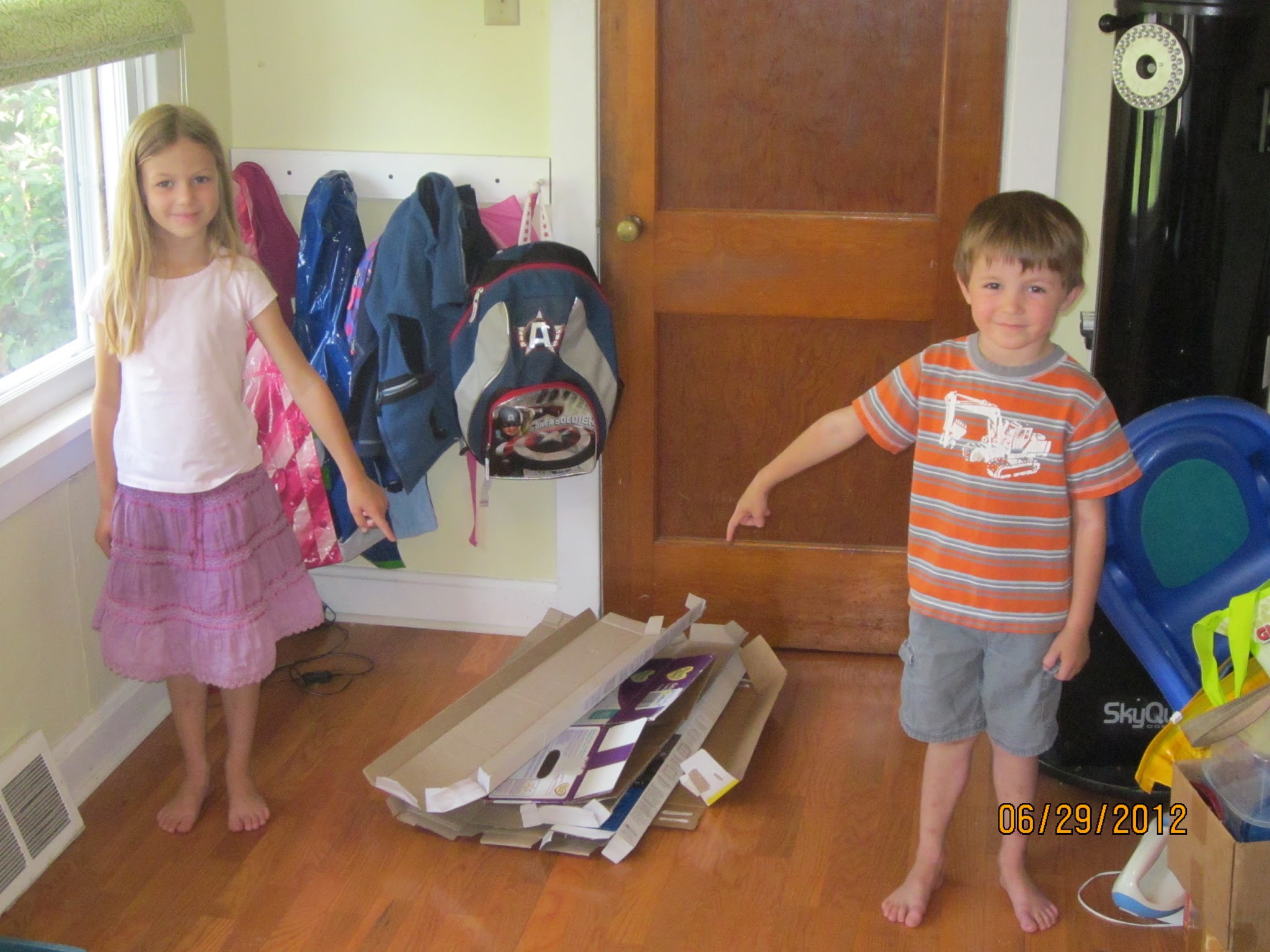
We’ll start on July 1 and continue through mid-August. We’re asking friends, neighbors and local businesses to help us meet our goal. Our friends at the South Side Deli have already agreed to donate!
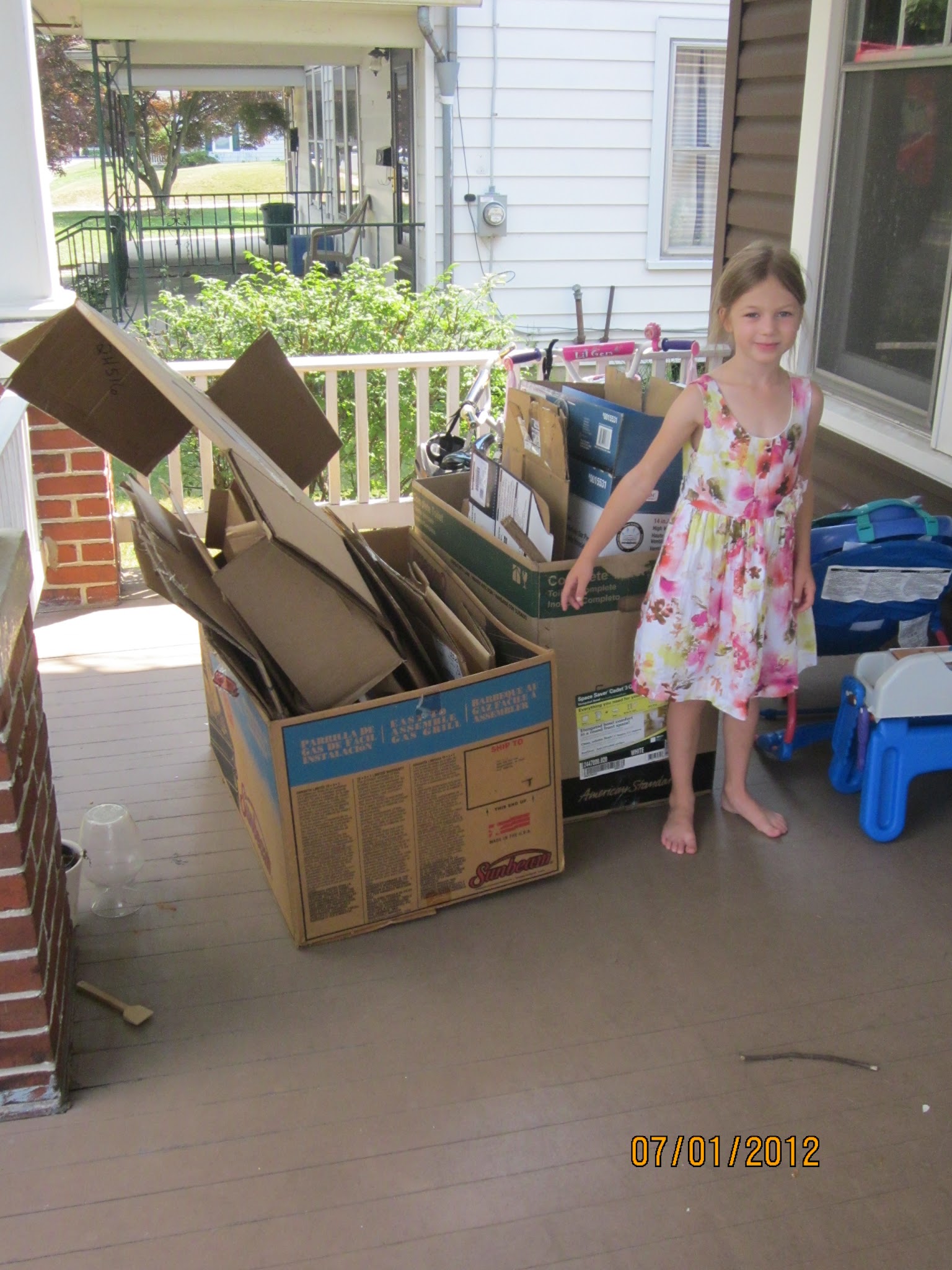
I’m so proud of my kids who went door to door on our street yesterday in the heat to invite our neighbors to donate. One elderly neighbor came to the door asking, “Now what are these kids selling?” I was pleased to reply, “Nothing!” Several neighbors commented on their respect for Project Share. Another elderly neighbor, who works installing furnaces and AC units, said he had a ton of boxes to get rid of and dropped them off this morning while we were out at church:
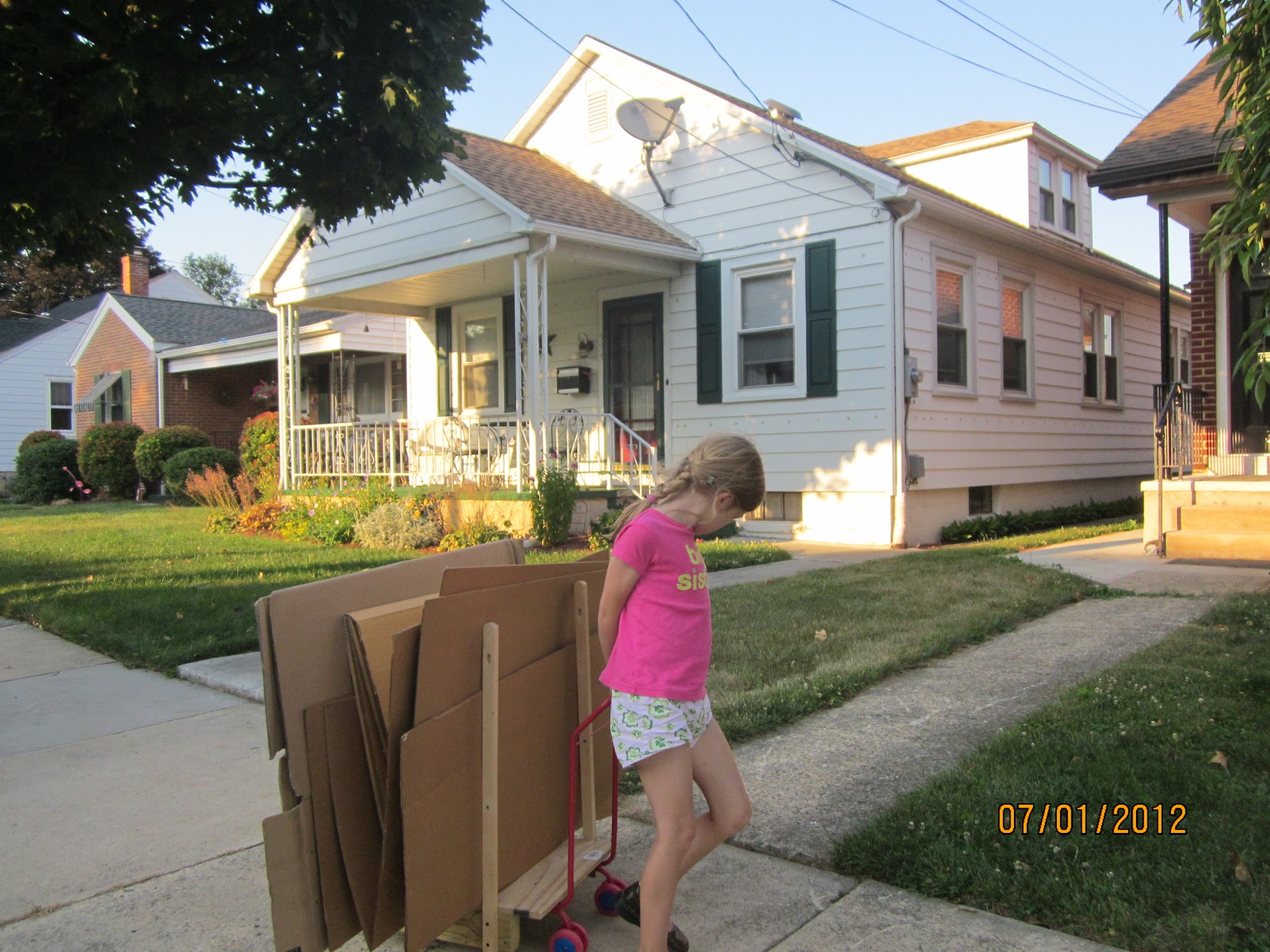
For the next month every Sunday evening (when trash and recycling go out on our street) we’ll go around to pick up any donations left out by our neighbors. Here’s Sophia with tonight’s haul:
If you’re local, please get involved either by adding to our collection or starting one of your own. Stay tuned for updates (will we make our goal??) and feel free to leave a word of encouragement here for all of us!
Sorry, Tom Cochran, Life is Not a Highway . . . (part 2)
If life’s a highway, there’s no chance to catch your breath. To stop and evaluate without the risk of falling behind.
The college I attended had a trail that ran through the woods. Along that trail there were other paths that branched off to a creek and an old farm field. I used to go lay in that field on a blanket in the sun and breeze. There was a tree in the middle of the field, as there often are, where farmers used to tie their horses to stop and rest at mid-day or enjoy a picnic lunch.
When you lay down in the middle of a field time and space open up around you. There’s no highway. There’s only the present. Weeds and flowers. Bugs and air and sun and sky. And you are small and in the middle of it all. And it’s not a bad feeling.
There’s no one path through the middle of a field that’s lain fallow for a long time. There are many paths. Some made by deer or mice. Places where the grass is pressed down for resting or the earth is dug up for a home or hideout. There’s no end and beginning; there are many sides. There’s no from and toward, only here and not here.
This isn’t to say there’s nowhere to go. Only that the pressure to go or stay disappears and exploring the field becomes a joy rather than a chore to be checked off of the eternal to-do list.
And let me tell you something else. God is in the field.
Now don’t get me wrong. He’s in the highways too, traveling with you in your car or van. But God’s most definitely in the fields. He likes to hang out there on off days. I’ve seen him there sprawled out on a blanket with a book in hand or just staring at the sky (God’s especially fond of looking for pictures in the clouds). Or sometimes flying a kite, enjoying the tug and pull of the string as the kite swoops and glides.
Man, I keep thinking about that field more and more these days.
I don’t live by the highway anymore. Just on a small side street in a semi-quiet town. I’m trying to let myself believe my life isn’t a highway. Maybe it’s a field. Maybe all the blessings that keep cropping up in my life, the ones that don’t fit into the plan and seem like distractions, are like wild flowers popping up scattered in a field. I’m starting to believe it. Maybe there’s nowhere else I have to be.
If you feel the need to keep on trucking, Godspeed and traveling mercies to you. But if you get tired and need a break, don’t forget about the field. I’ll be here. There’s plenty of room. Feel free to pull over and rest for awhile.
Where do you most often find God these days?
Sorry, Tom Cochran, Life is Not a Highway . . . (part 1)
If life’s a highway, I’m in trouble. Since having twins, my internal GPS is endlessly recalculating. Too often you’ll find me broken down on the side of the road, wishing I’d coughed up the money for triple A or paid more attention to the little light flashing on the dash. I’m surely late for one thing or another. I have friends who’ve made it much further than me. Friends with higher degrees, more developed careers, they’re due to arrive any time now.
I felt good when I turned 30, knowing I had checked off enough boxes on my to-do list. I was trucking right along.
But then something happened, life started taking strange turns. I forgot where I was headed and why. I started to notice little things on the side of the road. Signs pointing in different directions. I had children. And more children. We filled a sedan and then moved on to a van (it’s full now too). Our starter home is bursting at the seams and all signs are pointing toward a necessary upgrade in size, if not stature.
When I was in graduate school, I had the definitive sensation that life was a race (an academic one for sure, no sweating involved, unless it was due to intensity of thought). To succeed at the race you had to be like one of those inconceivably tall, thin runners who win medals at the Olympics. Stripped down to a tiny pair of running shorts, the lightest of shoes. Pressing on toward the prize. Forsaking all else.
I was good at running that race, it came naturally to me and the rush of running, of living like that, was amazing. It was like a drug.
We lived just outside of Princeton, within a block of Rt. 1, a major four-lane highway with cars rushing endlessly in both directions.
When you head west on Route 1 away from Princeton and get onto the PA turnpike, traffic slowly beings to lighten. The view along the side of the road changes from gas stations and box stores to woods and open fields. Sometimes there are deer grazing and if you look closely you might notice a cat hunting along the edge of a field or a hawk resting in a tree.
Driving along a change comes over me as the space around me opens up. I can see the horizon in the distance. And, seeing it, knowing it’s there, I find myself less compelled to rush endlessly after it.
How would you describe your life? Is it a highway? A race? Or something else altogether?
For Joy
Three out of four of the walking members of our household now own rain gear – specifically, rain boots.
So now, when it rains or a storm blows through, we three gear up and head out, not in. We put on our coats and boots and zip-up, not minding that by the end of our walk we’re likely to be wet through regardless. We stomp with exaggerated steps and point exuberantly at the river running in our street. We spy a drowned bee and mourn his demise (while also feeling relief that there’s one less stinger to fear).
The street and sidewalks are quiet, save for the rain and the sound of cars splashing by. My husband sits on the porch with the twins. Poor bootless man, we pity him.
Now, pretty much every time it rains my son asks with exuberance, “Mom, can I go out?” And I see no reason to say no.
The rains came again during my parent’s recent visit. The kids pulled on their boots and were out in a flash, marveling at the puddles, shouting and exclaiming at the wonder of it all in voices drowned out by the downpour. They stomped and splashed with great intensity and focus. Walking in water, making mighty splashes, is serious business.
My dad said, watching from the porch, “I remember doing that as a kid, but I don’t know why.”
“What do you mean?” I asked. He said, “I remember splashing in puddles, but I don’t know why I did it.”
“Because it’s fun,” is my reply.
And in my mind I think, for joy.
How many things do we do for joy any more? We do things for productivity and hope for joy as a bi-product, a happy bonus. But what if we, on occasion at least, switched our priorities?
Movies often mark a plot’s turn toward redemption with a rain storm or some other form of literal or figurative baptism. It’s common enough that I now know to look for it, the moment of grace that makes way for joy breaking through, like sun rays bursting through the clouds.
My kids and I are afraid sometimes on our rain walks, with thunder and lightening doing their bone-jarring call and response. I know it’s a little foolish to be out. But if there’s a rainbow or a waterlogged bee floating by, we’ll be the first to see it. And when we come back dripping with joy I know it’s been a moment of transformation for each of us.
Books

Between Heaven and Earth (poems)

Prayer can easily become an afterthought, a hasty sentence, a laundry list of all the things we want. But what if prayer is a time to find out what God wants for us–and for our world? What does it mean to pray that the kingdom would come here and now as it is in heaven? Explore these questions in this study, and learn prayer practices that nurture intimacy with God and sensitivity to God’s dream for the world.
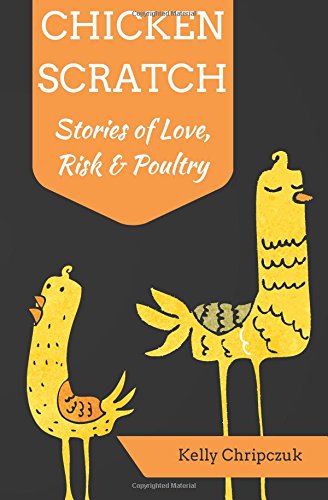
Follow this writer, spiritual director, and mother of four as she dives into the deep end of chicken farming and wrestles with the risks and rewards of living a life she loves. At turns hilarious, thoughtful, and always compassionate, Chicken Scratch will change the way you see the mess and chaos involved in living life to its fullest.
